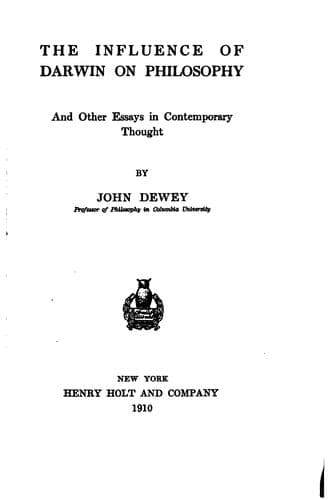
The Influence of Darwin on Philosophy, and other essays in contemporary thoughtDewey, John
Philosophy
The Influence of Darwin on Philosophy, and other essays in contemporary thought
Dewey, John
Evolution; Philosophy; Pragmatism
Anyway, the snubbed and excluded factor may always reassert itself.
The very pushing it out of “Reality” may but add to its potential
energy, and invoke a more violent recoil. When affections and
aversions, with the beliefs in which they record themselves and the
efforts they exact, are reduced to epiphenomena, dancing an idle
attendance upon a reality complete without them, to which they vainly
strive to accommodate themselves by mirroring, then may the emotions
flagrantly burst forth with the claim that, as a friend of mine puts
it, reason is _only_ a fig leaf for _their_ nakedness. When one
man says that need, uncertainty, choice, novelty, and strife have
no place in Reality, which is made up wholly of established things
behaving by foregone rules, then may another man be provoked to reply
that all such fixities, whether named atoms or God, whether they be
fixtures of a sensational, a positivistic, or an idealistic system,
have existence and import only in the problems, needs, struggles, and
instrumentalities of conscious agents and patients. For home rule may
be found in the unwritten efficacious constitution of experience.
That contemporaneously we are in the presence of such a reaction is
apparent. Let us, in pursuit of our topic, inquire how it came about
and why it takes the form that it takes. This consideration may not
only occupy the hour, but may help diagram some future parallelogram
of forces. The account calls for some sketching (1) of the historical
tendencies which have shaped the situation in which a Stoic theory of
knowledge claims metaphysical monopoly, and (2) of the tendencies that
have furnished the despised principle of belief opportunity and means
of reassertion.
II
Imagination readily travels to a period when a gospel of intense,
and, one may say, deliberate passionate disturbance appeared to be
conquering the Stoic ideal of passionless reason; when the demand
for individual assertion by faith against the established, embodied
objective order was seemingly subduing the idea of the total
subordination of the individual to the universal. By what course
of events came about the dramatic reversal, in which an ethically
conquered Stoicism became the conqueror, epistemologically, of
Christianity?
How are our imaginations haunted by the idea of what might have
happened if Christianity had found ready to its hand intellectual
formulations corresponding to its practical proclamations!
Public-domain text, read in full here on John Shaqi.
Reviews
Reviews
No reviews yet
Be the first to share your thoughts on this work.
Elsewhere in the archive
Join the Discussion
Join the discussion
Sign in to leave a comment or review.
Sign InorCreate an account