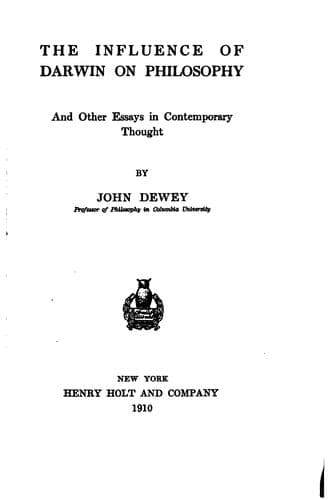
The Influence of Darwin on Philosophy, and other essays in contemporary thoughtDewey, John
Philosophy
The Influence of Darwin on Philosophy, and other essays in contemporary thought
Dewey, John
Evolution; Philosophy; Pragmatism
That the ultimate principle of conduct is affectional and volitional;
that God is love; that access to the principle is by faith, a personal
attitude; that belief, surpassing logical basis and warrant, works
out through its own operation its own fulfilling evidence: such was
the implied moral metaphysic of Christianity. But this implication
needed to become a theory, a theology, a formulation; and in this
need, it found no recourse save to philosophies that had identified
true existence with the proper object of logical reason. For, in Greek
thought, after the valuable meanings, the meanings of industry and art
that appealed to sustained and serious choice, had given birth and
status to reflective reason, reason denied its ancestry of organized
endeavor, and proclaimed itself in its function of self-conscious
logical thought to be the author and warrant of all genuine things.
Yet how nearly Christianity had found prepared for it the needed means
of its own intellectual statement! We recall Aristotle’s account
of moral knowing, and his definition of man. Man as man, he tells
us, is a principle that may be termed either desiring thought or
thinking desire. Not as pure intelligence does _man_ know, but as an
organization of desires effected through reflection upon their own
conditions and consequences. What if Aristotle had only assimilated
his idea of theoretical to his notion of practical knowledge! Because
practical thinking was so human, Aristotle rejected it in favor of
pure, passionless cognition, something superhuman. Thinking desire is
experimental, is tentative, not absolute. It looks to the future and
to the past for help in the future. It is contingent, not necessary.
It doubly relates to the individual: to the individual thing as
experienced by an individual agent; not to the universal. Hence
desire is a sure sign of defect, of privation, of non-being, and
seeks surcease in something which knows it not. Hence desiring reason
culminating in beliefs relating to imperfect existence, stands forever
in contrast with passionless reason functioning in pure knowledge,
logically complete, of perfect being.
Public-domain text, read in full here on John Shaqi.
Reviews
Reviews
No reviews yet
Be the first to share your thoughts on this work.
Elsewhere in the archive
Join the Discussion
Join the discussion
Sign in to leave a comment or review.
Sign InorCreate an account