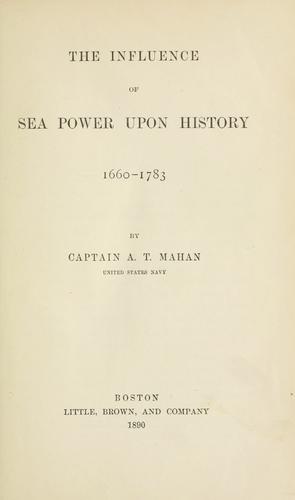
The Influence of Sea Power Upon History, 1660-1783Mahan, A. T. (Alfred Thayer)
History
The Influence of Sea Power Upon History, 1660-1783
Mahan, A. T. (Alfred Thayer)
Naval history, Modern; Sea-power
"The naval and commercial power of the republic developed
rapidly. The merchant fleet of Holland alone numbered 10,000
sail, 168,000 seamen, and supported 260,000 inhabitants. She had
taken possession of the greater part of the European
carrying-trade, and had added thereto, since the peace, all the
carriage of merchandise between America and Spain, did the same
service for the French ports, and maintained an importation
traffic of thirty-six million francs. The north countries,
Brandenburg, Denmark, Sweden, Muscovy, Poland, access to which
was opened by the Baltic to the Provinces, were for them an
inexhaustible market of exchange. They fed it by the produce
they sold there, and by purchase of the products of the
North,--wheat, timber, copper, hemp, and furs. The total value
of merchandise yearly shipped in Dutch bottoms, in all seas,
exceeded a thousand million francs. The Dutch had made
themselves, to use a contemporary phrase, the wagoners of all
seas."[18]
It was through its colonies that the republic had been able thus to
develop its sea trade. It had the monopoly of all the products of the
East. Produce and spices from Asia were by her brought to Europe of a
yearly value of sixteen million francs. The powerful East India
Company, founded in 1602, had built up in Asia an empire, with
possessions taken from the Portuguese. Mistress in 1650 of the Cape of
Good Hope, which guaranteed it a stopping-place for its ships, it
reigned as a sovereign in Ceylon, and upon the coasts of Malabar and
Coromandel. It had made Batavia its seat of government, and extended
its traffic to China and Japan. Meanwhile the West India Company, of
more rapid rise, but less durable, had manned eight hundred ships of
war and trade. It had used them to seize the remnants of Portuguese
power upon the shores of Guinea, as well as in Brazil.
The United Provinces had thus become the warehouse wherein were
collected the products of all nations.
The colonies of the Dutch at this time were scattered throughout the
eastern seas, in India, in Malacca, in Java, the Moluccas, and various
parts of the vast archipelago lying to the northward of Australia.
They had possessions on the west coast of Africa, and as yet the
colony of New Amsterdam remained in their hands. In South America the
Dutch West India Company had owned nearly three hundred leagues of
coast from Bahia in Brazil northward; but much had recently escaped
from their hands.
Public-domain text, read in full here on John Shaqi.
Reviews
Reviews
No reviews yet
Be the first to share your thoughts on this work.
Elsewhere in the archive
Join the Discussion
Join the discussion
Sign in to leave a comment or review.
Sign InorCreate an account