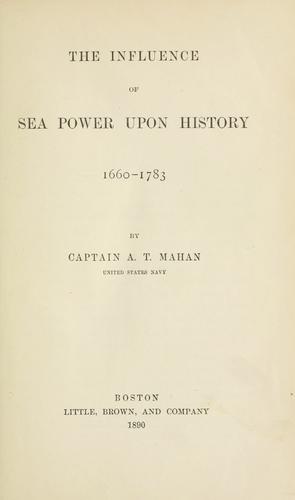
The Influence of Sea Power Upon History, 1660-1783Mahan, A. T. (Alfred Thayer)
History
The Influence of Sea Power Upon History, 1660-1783
Mahan, A. T. (Alfred Thayer)
Naval history, Modern; Sea-power
The general character of the government has been before mentioned, and
need here only be recalled. It was a loosely knit confederacy,
administered by what may not inaccurately be called a commercial
aristocracy, with all the political timidity of that class, which has
so much to risk in war. The effect of these two factors, sectional
jealousy and commercial spirit, upon the military navy was disastrous.
It was not kept up properly in peace, there were necessarily rivalries
in a fleet which was rather a maritime coalition than a united navy,
and there was too little of a true military spirit among the officers.
A more heroic people than the Dutch never existed; the annals of Dutch
sea-fights give instances of desperate enterprise and endurance
certainly not excelled, perhaps never equalled, elsewhere; but they
also exhibit instances of defection and misconduct which show a lack
of military spirit, due evidently to lack of professional pride and
training. This professional training scarcely existed in any navy of
that day, but its place was largely supplied in monarchical countries
by the feeling of a military caste. It remains to be noted that the
government, weak enough from the causes named, was yet weaker from the
division of the people into two great factions bitterly hating each
other. The one, which was the party of the merchants (burgomasters),
and now in power, favored the confederate republic as described; the
other desired a monarchical government under the House of Orange. The
Republican party wished for a French alliance, if possible, and a
strong navy; the Orange party favored England, to whose royal house
the Prince of Orange was closely related, and a powerful army. Under
these conditions of government, and weak in numbers, the United
Provinces in 1660, with their vast wealth and external activities,
resembled a man kept up by stimulants. Factitious strength cannot
endure indefinitely; but it is wonderful to see this small State,
weaker by far in numbers than either England or France, endure the
onslaught of either singly, and for two years of both in alliance, not
only without being destroyed, but without losing her place in Europe.
She owed this astonishing result partly to the skill of one or two
men, but mainly to her sea power.
Public-domain text, read in full here on John Shaqi.
Reviews
Reviews
No reviews yet
Be the first to share your thoughts on this work.
Elsewhere in the archive
Join the Discussion
Join the discussion
Sign in to leave a comment or review.
Sign InorCreate an account