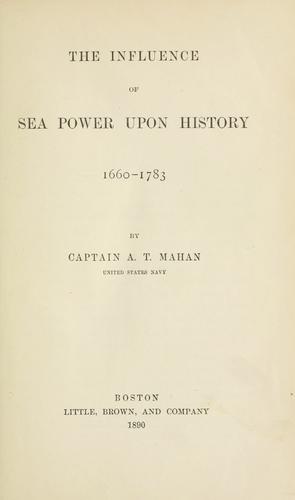
The Influence of Sea Power Upon History, 1660-1783Mahan, A. T. (Alfred Thayer)
History
The Influence of Sea Power Upon History, 1660-1783
Mahan, A. T. (Alfred Thayer)
Naval history, Modern; Sea-power
The conditions of England, with reference to her fitness to enter upon
the impending strife, differed from those of both Holland and France.
Although monarchical in government, and with much real power in the
king's hands, the latter was not able to direct the policy of the
kingdom wholly at his will. He had to reckon, as Louis had not, with
the temper and wishes of his people. What Louis gained for France, he
gained for himself; the glory of France was his glory. Charles aimed
first at his own advantage, then at that of England; but, with the
memory of the past ever before him, he was determined above all not to
incur his father's fate nor a repetition of his own exile. Therefore,
when danger became imminent, he gave way before the feeling of the
English nation. Charles himself hated Holland; he hated it as a
republic; he hated the existing government because opposed in internal
affairs to his connections, the House of Orange; and he hated it yet
more because in the days of his exile, the republic, as one of the
conditions of peace with Cromwell, had driven him from her borders. He
was drawn to France by the political sympathy of a would-be absolute
ruler, possibly by his Roman Catholic bias, and very largely by the
money paid him by Louis, which partially freed him from the control of
Parliament. In following these tendencies of his own, Charles had to
take account of certain decided wishes of his people. The English, of
the same race as the Dutch, and with similar conditions of situation,
were declared rivals for the control of the sea and of commerce; and
as the Dutch were now leading in the race, the English were the more
eager and bitter. A special cause of grievance was found in the action
of the Dutch East India Company, "which claimed the monopoly of trade
in the East, and had obliged distant princes with whom it treated to
close their States to foreign nations, who were thus excluded, not
only from the Dutch colonies, but from all the territory of the
Indies." Conscious of greater strength, the English also wished to
control the action of Dutch politics, and in the days of the English
Republic had even sought to impose a union of the two governments. At
the first, therefore, popular rivalry and enmity seconded the king's
wishes; the more so as France had not for some years been formidable
on the continent. As soon, however, as the aggressive policy of Louis
XIV. was generally recognized, the English people, both nobles and
commons, felt the great danger to be there, as a century before it had
been in Spain. The transfer of the Spanish Netherlands (Belgium) to
France would tend toward the subjection of Europe, and especially
would be a blow to the sea power both of the Dutch and English; for it
was not to be supposed that Louis would allow the Scheldt and port of
Antwerp to remain closed, as they then were, under a treaty wrung by
the Dutch from the weakness of Spain. The reopening to commerce of
Public-domain text, read in full here on John Shaqi.
Reviews
Reviews
No reviews yet
Be the first to share your thoughts on this work.
Elsewhere in the archive
Join the Discussion
Join the discussion
Sign in to leave a comment or review.
Sign InorCreate an account