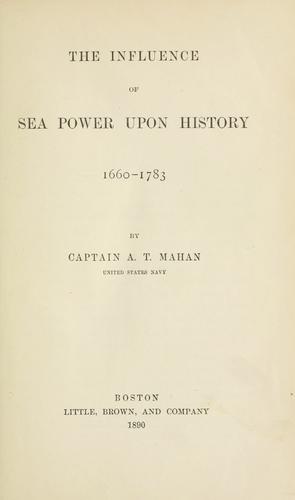
The Influence of Sea Power Upon History, 1660-1783Mahan, A. T. (Alfred Thayer)
History
The Influence of Sea Power Upon History, 1660-1783
Mahan, A. T. (Alfred Thayer)
Naval history, Modern; Sea-power
Thus as briefly as possible have been sketched the conditions, degree
of power, and aims which shaped and controlled the policy of the four
principal seaboard States of the day,--Spain, France, England, and
Holland. From the point of view of this history, these will come most
prominently and most often into notice; but as other States exercised
a powerful influence upon the course of events, and our aim is not
merely naval history but an appreciation of the effect of naval and
commercial power upon the course of general history, it is necessary
to state shortly the condition of the rest of Europe. America had not
yet begun to play a prominent part in the pages of history or in the
policies of cabinets.
Germany was then divided into many small governments, with the one
great empire of Austria. The policy of the smaller States shifted, and
it was the aim of France to combine as many of them as possible under
her influence, in pursuance of her traditional opposition to Austria.
With France thus working against her on the one side, Austria was in
imminent peril on the other from the constant assaults of the Turkish
Empire, still vigorous though decaying. The policy of France had long
inclined to friendly relations with Turkey, not only as a check upon
Austria, but also from her wish to engross the trade with the Levant.
Colbert, in his extreme eagerness for the sea power of France, favored
this alliance. It will be remembered that Greece and Egypt were then
parts of the Turkish Empire.
Prussia as now known did not exist. The foundations of the future
kingdom were then being prepared by the Elector of Brandenburg, a
powerful minor State, which was not yet able to stand quite alone, but
carefully avoided a formally dependent position. The kingdom of Poland
still existed, a most disturbing and important factor in European
politics, because of its weak and unsettled government, which kept
every other State anxious lest some unforeseen turn of events there
should tend to the advantage of a rival. It was the traditional policy
of France to keep Poland upright and strong. Russia was still below
the horizon; coming, but not yet come, within the circle of European
States and their living interests. She and the other powers bordering
upon the Baltic were naturally rivals for preponderance in that sea,
in which the other States, and above all the maritime States, had a
particular interest as the source from which naval stores of every
kind were chiefly drawn. Sweden and Denmark were at this time in a
state of constant enmity, and were to be found on opposite sides in
the quarrels that prevailed. For many years past, and during the early
wars of Louis XIV., Sweden was for the most part in alliance with
France; her bias was that way.
Public-domain text, read in full here on John Shaqi.
Reviews
Reviews
No reviews yet
Be the first to share your thoughts on this work.
Elsewhere in the archive
Join the Discussion
Join the discussion
Sign in to leave a comment or review.
Sign InorCreate an account