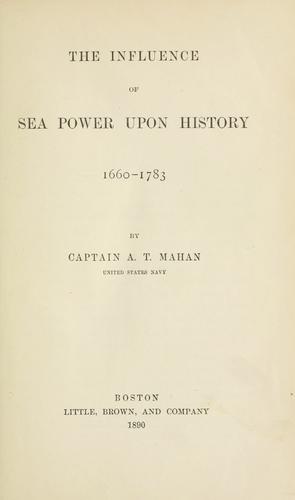
The Influence of Sea Power Upon History, 1660-1783Mahan, A. T. (Alfred Thayer)
History
The Influence of Sea Power Upon History, 1660-1783
Mahan, A. T. (Alfred Thayer)
Naval history, Modern; Sea-power
that great city would be a blow alike to Amsterdam and to London. With
the revival of inherited opposition to France the ties of kindred
began to tell; the memory of past alliance against the tyranny of
Spain was recalled; and similarity of religious faith, still a
powerful motive, drew the two together. At the same time the great and
systematic efforts of Colbert to build up the commerce and the navy of
France excited the jealousy of both the sea powers; rivals themselves,
they instinctively turned against a third party intruding upon their
domain. Charles was unable to resist the pressure of his people under
all these motives; wars between England and Holland ceased, and were
followed, after Charles's death, by close alliance.
Although her commerce was less extensive, the navy of England in 1660
was superior to that of Holland, particularly in organization and
efficiency. The stern, enthusiastic religious government of Cromwell,
grounded on military strength, had made its mark both on the fleet and
army. The names of several of the superior officers under the
Protector, among which that of Monk stands foremost, appear in the
narrative of the first of the Dutch wars under Charles. This
superiority in tone and discipline gradually disappeared under the
corrupting influence of court favor in a licentious government; and
Holland, which upon the whole was worsted by England alone upon the
sea in 1665, successfully resisted the combined navies of England and
France in 1672. As regards the material of the three fleets, we are
told that the French ships had greater displacement than the English
relatively to the weight of artillery and stores; hence they could
keep, when fully loaded, a greater height of battery. Their hulls also
had better lines. These advantages would naturally follow from the
thoughtful and systematic way in which the French navy at that time
was restored from a state of decay, and has a lesson of hope for us in
the present analogous condition of our own navy. The Dutch ships, from
the character of their coast, were flatter-bottomed and of less
draught, and thus were able, when pressed, to find a refuge among the
shoals; but they were in consequence less weatherly and generally of
lighter scantling than those of either of the other nations.
Public-domain text, read in full here on John Shaqi.
Reviews
Reviews
No reviews yet
Be the first to share your thoughts on this work.
Elsewhere in the archive
Join the Discussion
Join the discussion
Sign in to leave a comment or review.
Sign InorCreate an account