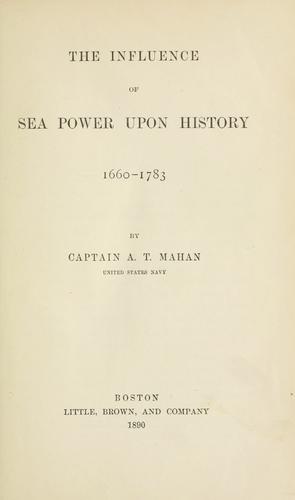
The Influence of Sea Power Upon History, 1660-1783Mahan, A. T. (Alfred Thayer)
History
The Influence of Sea Power Upon History, 1660-1783
Mahan, A. T. (Alfred Thayer)
Naval history, Modern; Sea-power
There was one well-known feature of all the military navies of that
day which calls for a passing comment; for its correct bearing and
value is not always, perhaps not generally, seen. The command of
fleets and of single vessels was often given to soldiers, to military
men unaccustomed to the sea, and ignorant how to handle the ship, that
duty being intrusted to another class of officer. Looking closely into
the facts, it is seen that this made a clean division between the
direction of the fighting and of the motive power of the ship. This is
the essence of the matter; and the principle is the same whatever the
motive power may be. The inconvenience and inefficiency of such a
system was obvious then as it is now, and the logic of facts gradually
threw the two functions into the hands of one corps of officers, the
result being the modern naval officer, as that term is generally
understood.[36] Unfortunately, in this process of blending, the less
important function was allowed to get the upper hand; the naval
officer came to feel more proud of his dexterity in managing the
motive power of his ship than of his skill in developing her military
efficiency. The bad effects of this lack of interest in military
science became most evident when the point of handling fleets was
reached, because for that military skill told most, and previous study
was most necessary; but it was felt in the single ship as well. Hence
it came to pass, and especially in the English navy, that the pride of
the seaman took the place of the pride of the military man. The
English naval officer thought more of that which likened him to the
merchant captain than of that which made him akin to the soldier. In
the French navy this result was less general, owing probably to the
more military spirit of the government, and especially of the
nobility, to whom the rank of officer was reserved. It was not
possible that men whose whole association was military, all of whose
friends looked upon arms as the one career for a gentleman, could
think more of the sails and rigging than of the guns or the fleet. The
English corps of officers was of different origin. There was more than
the writer thought in Macaulay's well-known saying: "There were seamen
and there were gentlemen in the navy of Charles II.; but the seamen
were not gentlemen, and the gentlemen were not seamen." The trouble
was not in the absence or presence of gentlemen as such, but in the
fact that under the conditions of that day the gentleman was
pre-eminently the military element of society; and that the seaman,
after the Dutch wars, gradually edged the gentleman, and with him the
military tone and spirit as distinguished from simple courage, out of
the service. Even "such men of family as Herbert and Russell, William
III.'s admirals," says the biographer of Lord Hawke, "were sailors
indeed, but only able to hold their own by adopting the boisterous
manners of the hardy tarpaulin." The same national traits which made
Public-domain text, read in full here on John Shaqi.
Reviews
Reviews
No reviews yet
Be the first to share your thoughts on this work.
Elsewhere in the archive
Join the Discussion
Join the discussion
Sign in to leave a comment or review.
Sign InorCreate an account