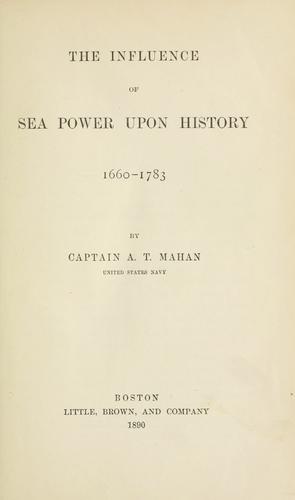
The Influence of Sea Power Upon History, 1660-1783Mahan, A. T. (Alfred Thayer)
History
The Influence of Sea Power Upon History, 1660-1783
Mahan, A. T. (Alfred Thayer)
Naval history, Modern; Sea-power
the French inferior as seamen made them superior as military men; not
in courage, but in skill. To this day the same tendency obtains; the
direction of the motive power has no such consideration as the
military functions in the navies of the Latin nations. The studious
and systematic side of the French character also inclined the French
officer, when not a trifler, to consider and develop tactical
questions in a logical manner; to prepare himself to handle fleets,
not merely as a seaman but as a military man. The result showed, in
the American Revolutionary War, that despite a mournful history of
governmental neglect, men who were first of all military men, inferior
though they were in opportunities as seamen to their enemies, could
meet them on more than equal terms as to tactical skill, and were
practically their superiors in handling fleets. The false theory has
already been pointed out, which directed the action of the French
fleet not to crushing its enemy, but to some ulterior aim; but this
does not affect the fact that in tactical skill the military men were
superior to the mere seamen, though their tactical skill was applied
to mistaken strategic ends. The source whence the Dutch mainly drew
their officers does not certainly appear; for while the English naval
historian in 1666 says that most of the captains of their fleet were
sons of rich burgomasters, placed there for political reasons by the
Grand Pensionary, and without experience, Duquesne, the ablest French
admiral of the day, comments in 1676 on the precision and skill of the
Dutch captains in terms very disparaging to his own. It is likely,
from many indications, that they were generally merchant seamen, with
little original military feeling; but the severity with which the
delinquents were punished both by the State and by popular frenzy,
seems to have driven these officers, who were far from lacking the
highest personal courage, into a sense of what military loyalty and
subordination required. They made a very different record in 1672 from
that of 1666.
Before finally leaving the Four Days' Fight, the conclusions of
another writer may well be quoted:--
Public-domain text, read in full here on John Shaqi.
Reviews
Reviews
No reviews yet
Be the first to share your thoughts on this work.
Elsewhere in the archive
Join the Discussion
Join the discussion
Sign in to leave a comment or review.
Sign InorCreate an account