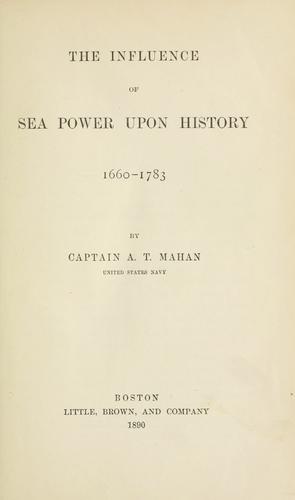
The Influence of Sea Power Upon History, 1660-1783Mahan, A. T. (Alfred Thayer)
History
The Influence of Sea Power Upon History, 1660-1783
Mahan, A. T. (Alfred Thayer)
Naval history, Modern; Sea-power
During the years preceding the war the Dutch made every diplomatic
effort to avert it, but the hatred of Charles and Louis prevented any
concession being accepted as final. An English royal yacht was ordered
to pass through the Dutch ships-of-war in the Channel, and to fire on
them if they did not strike their flags. In January, 1672, England
sent an ultimatum, summoning Holland to acknowledge the right of the
English crown to the sovereignty of the British seas, and to order its
fleets to lower their flags to the smallest English man-of-war; and
demands such as these received the support of a French king. The Dutch
continued to yield, but seeing at length that all concessions were
useless, they in February ordered into commission seventy-five
ships-of-the-line, besides smaller vessels. On the 23d of March the
English, without declaration of war, attacked a fleet of Dutch
merchantmen; and on the 29th the king declared war. This was followed,
April 6th, by the declaration of Louis XIV.; and on the 28th of the
same month he set out to take command in person of his army.
The war which now began, including the third and last of the great
contests between the English and Dutch upon the ocean, was not, like
those before it, purely a sea war; and it will be necessary to mention
its leading outlines on the land also, not only in order to clearness
of impression, but also to bring out the desperate straits to which
the republic was reduced, and the final deliverance through its sea
power in the hands of the great seaman De Ruyter.
Public-domain text, read in full here on John Shaqi.
Reviews
Reviews
No reviews yet
Be the first to share your thoughts on this work.
Elsewhere in the archive
Join the Discussion
Join the discussion
Sign in to leave a comment or review.
Sign InorCreate an account