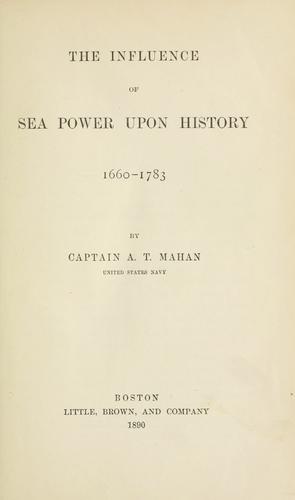
The Influence of Sea Power Upon History, 1660-1783Mahan, A. T. (Alfred Thayer)
History
The Influence of Sea Power Upon History, 1660-1783
Mahan, A. T. (Alfred Thayer)
Naval history, Modern; Sea-power
Those who are familiar with Clerk's work on naval tactics, published
about 1780, will recognize in this account of the battle of Stromboli
all the features to which he called the attention of English seamen in
his thesis on the methods of action employed by them and their
adversaries in and before his time. Clerk's thesis started from the
postulate that English seamen and officers were superior in skill or
spirit, or both, to the French, and their ships on the whole as fast;
that they were conscious of this superiority and therefore eager to
attack, while the French, equally conscious of inferiority, or for
other reasons, were averse to decisive engagements. With these
dispositions the latter, feeling they could rely on a blindly furious
attack by the English, had evolved a crafty plan by which, while
seeming to fight, they really avoided doing so, and at the same time
did the enemy much harm. This plan was to take the lee-gage, the
characteristic of which, as has before been pointed out, is that it is
a defensive position, and to await attack. The English error,
according to Clerk, upon which the French had learned by experience
that they could always count, was in drawing up their line parallel to
the enemy, or nearly so, and then keeping away all together to attack,
ship for ship, each its opposite in the hostile line. By standing down
in this manner the assailant lost the use of most of his artillery,
while exposed to the full fire of his opponent, and invariably came up
in confusion, because the order of attack was one difficult to
maintain at any time, and much more so in the smoke under fire, with
torn sails and falling masts. This was precisely the attack made by
Duquesne at Stromboli, and it there had precisely the consequences
Clerk points out,--confusion in the line, the van arriving first and
getting the brunt of the fire of the defence, disabled ships in the
van causing confusion in the rear, etc. Clerk further asserts, and he
seems to be right, that as the action grew warm, the French, by
running off to leeward, in their turn, led the English to repeat the
same mode of attack;[61] and so we find, at Stromboli, Ruyter giving
ground in the same way, though his motive does not appear. Clerk also
points out that a necessary corollary of the lee-gage, assumed for
tactical reasons, is to aim at the assailant's spars, his motive
power, so that his attack cannot be pushed farther than the defendant
chooses, and at Stromboli the crippled condition of the French is
evident; for after Ruyter had fallen to leeward, and could no longer
help his separated rear, it was practically unmolested by the French,
although none of these had been sunk. While therefore there cannot
with certainty be attributed to Ruyter the deliberate choice of the
lee-gage, for which there was as yet no precedent, it is evident that
he reaped all its benefits, and that the character of the French
officers of his day, inexperienced as seamen and of impetuous valor,
Public-domain text, read in full here on John Shaqi.
Reviews
Reviews
No reviews yet
Be the first to share your thoughts on this work.
Elsewhere in the archive
Join the Discussion
Join the discussion
Sign in to leave a comment or review.
Sign InorCreate an account