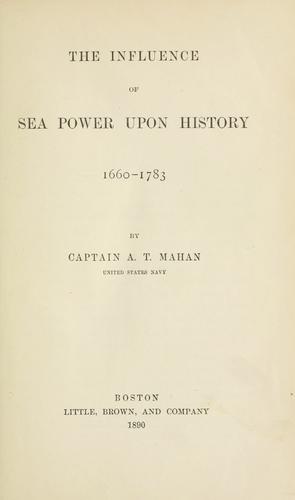
The Influence of Sea Power Upon History, 1660-1783Mahan, A. T. (Alfred Thayer)
History
The Influence of Sea Power Upon History, 1660-1783
Mahan, A. T. (Alfred Thayer)
Naval history, Modern; Sea-power
offered just the conditions that gave most advantage to an inferior
force standing on the defensive. The qualities and characteristics of
the enemy are among the principal factors which a man of genius
considers, and it was to this as much as to any other one trait that
Nelson owed his dazzling successes. On the other hand, the French
admiral attacked in a wholly unscientific manner, ship against ship,
without an attempt to concentrate on a part of the enemy, or even
trying to keep him in play until the French squadron of eight
ships-of-the-line in Messina, near by, could join. Such tactics cannot
be named beside that of Solebay or the Texel; but as Duquesne was the
best French officer of the century, with the possible exception of
Tourville, this battle has a value of its own in the history of
tactics, and may by no means be omitted. The standing of the
commander-in-chief is the warrant that it marks the highest point to
which French naval tactics has as yet attained. Before quitting this
discussion, it may be noted that the remedy Clerk proposed was to
attack the rear ships of the enemy's line, and preferably to leeward;
the remainder of the fleet must then either abandon them or stand down
for a general action, which according to his postulate was all that
the English seamen desired.
After the fight De Ruyter sailed to Palermo, one of his ships sinking
on the way. Duquesne was joined outside Messina by the French division
that had been lying there. The remaining incidents of the Sicilian war
are unimportant to the general subject. On the 22d of April, De Ruyter
and Duquesne met again off Agosta. Duquesne had twenty-nine ships, the
allied Spaniards and Dutch twenty-seven, of which ten were Spanish.
Unfortunately the Spaniard commanded in chief, and took the centre of
the line with the ships of his country, contrary to the advice of
Ruyter, who, knowing how inefficient his allies were, wished to
scatter them through the line and so support them better. Ruyter
himself took the van, and the allies, having the wind, attacked; but
the Spanish centre kept at long cannon range, leaving the brunt of the
battle to fall on the Dutch van. The rear, following the
commander-in-chief's motions, was also but slightly engaged. In this
sorrowful yet still glorious fulfilment of hopeless duty, De Ruyter,
who never before in his long career had been struck by an enemy's
shot, received a mortal wound. He died a week later at Syracuse, and
with him passed away the last hope of resistance on the sea. A month
later the Spanish and Dutch fleets were attacked at anchor at Palermo,
and many of them destroyed; while a division sent from Holland to
reinforce the Mediterranean fleet was met by a French squadron in the
Straits of Gibraltar and forced to take refuge in Cadiz.
Public-domain text, read in full here on John Shaqi.
Reviews
Reviews
No reviews yet
Be the first to share your thoughts on this work.
Elsewhere in the archive
Join the Discussion
Join the discussion
Sign in to leave a comment or review.
Sign InorCreate an account