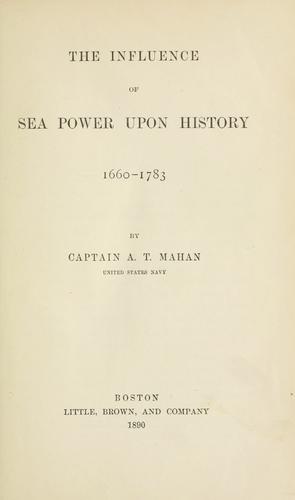
The Influence of Sea Power Upon History, 1660-1783Mahan, A. T. (Alfred Thayer)
History
The Influence of Sea Power Upon History, 1660-1783
Mahan, A. T. (Alfred Thayer)
Naval history, Modern; Sea-power
The exhaustion of the United Provinces and the clamor of their
merchants and peace party on the one hand, aided on the other by the
sufferings of France, the embarrassment of her finances, and the
threatened addition of England's navy to her already numerous enemies,
inclined to peace the two principal parties to this long war. Louis
had long been willing to make peace with Holland alone; but the States
had been withheld, at first by fidelity to those who had joined them
in their hour of trouble, and latterly by the firm purpose of William
of Orange. Difficulties were gradually smoothed away, and the Peace of
Nimeguen between the United Provinces and France was signed August 11,
1678. The other powers shortly afterward acceded to it. The principal
sufferer, as was natural, was the overgrown but feeble monarchy whose
centre was Spain, which gave up to France Franche Comté and a number
of fortified towns in the Spanish Netherlands, thus extending the
boundaries of France to the east and northeast. Holland, for whose
destruction Louis began the war, lost not a foot of ground in Europe;
and beyond the seas only her colonies on the west coast of Africa and
in Guiana. She owed her safety at first, and the final successful
issue, to her sea power. That delivered her in the hour of extreme
danger, and enabled her afterward to keep alive the general war. It
may be said to have been one of the chief factors, and inferior to no
other one singly, in determining the event of the great war which was
formally closed at Nimeguen.
Public-domain text, read in full here on John Shaqi.
Reviews
Reviews
No reviews yet
Be the first to share your thoughts on this work.
Elsewhere in the archive
Join the Discussion
Join the discussion
Sign in to leave a comment or review.
Sign InorCreate an account