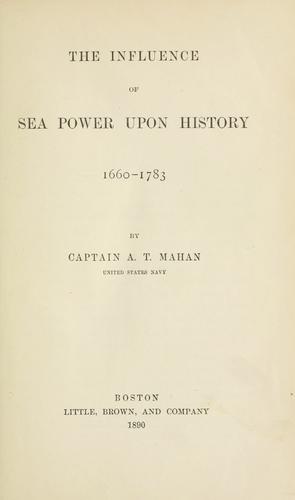
The Influence of Sea Power Upon History, 1660-1783Mahan, A. T. (Alfred Thayer)
History
The Influence of Sea Power Upon History, 1660-1783
Mahan, A. T. (Alfred Thayer)
Naval history, Modern; Sea-power
Still less was it to the interest of Holland to prolong the war, after
Louis showed a wish for peace. A continental war could at best be but
a necessary evil, and source of weakness to her. The money she spent
on her own and the allied armies was lost to her navy, and the sources
of her prosperity on the sea were being exhausted. How far the Prince
of Orange was justified, by the aims of Louis XIV., in that unyielding
attitude of opposition toward him which he always maintained, may be
uncertain, and there is here no need to decide the question; but there
can be no doubt that the strife sacrificed the sea power of Holland
through sheer exhaustion, and with it destroyed her position among
the nations of the world. "Situated between France and England," says
a historian of Holland, "by one or other of them were the United
Provinces, after they had achieved their independence of Spain,
constantly engaged in wars, which exhausted their finances,
annihilated their navy, and caused the rapid decline of their trade,
manufactures, and commerce; and thus a peace-loving nation found
herself crushed by the weight of unprovoked and long-continued
hostilities. Often, too, the friendship of England was scarcely less
harmful to Holland than her enmity. As one increased and the other
lessened, it became the alliance of the giant and the dwarf."[62]
Hitherto we have seen Holland the open enemy or hearty rival of
England; henceforward she appears as an ally,--in both cases a
sufferer from her smaller size, weaker numbers, and less favored
situation.
Public-domain text, read in full here on John Shaqi.
Reviews
Reviews
No reviews yet
Be the first to share your thoughts on this work.
Elsewhere in the archive
Join the Discussion
Join the discussion
Sign in to leave a comment or review.
Sign InorCreate an account