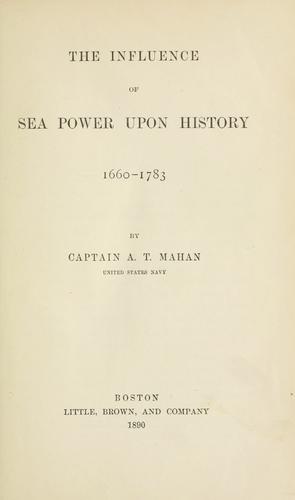
The Influence of Sea Power Upon History, 1660-1783Mahan, A. T. (Alfred Thayer)
History
The Influence of Sea Power Upon History, 1660-1783
Mahan, A. T. (Alfred Thayer)
Naval history, Modern; Sea-power
Taught by the experience of the last conflict, the chief effort of the
French king, in the general war he had brought upon himself, should
have been directed against the sea powers,--against William of Orange
and the Anglo-Dutch alliance. The weakest point in William's position
was Ireland; though in England itself not only were there many
partisans of the exiled king, but even those who had called in William
fenced his kingship about with jealous restrictions. His power was not
secure so long as Ireland was not subdued. James, having fled from
England in January, 1689, landed in Ireland in the following March,
accompanied by French troops and a French squadron, and was
enthusiastically welcomed everywhere but in the Protestant North. He
made Dublin his capital, and remained in the country until July of the
next year. During these fifteen months the French were much superior
at sea; they landed troops in Ireland on more than one occasion; and
the English, attempting to prevent this, were defeated in the naval
battle of Bantry Bay.[68] But although James was so well established,
and it was of the utmost importance to sustain him; although it was
equally important to keep William from getting a foothold till James
was further strengthened and Londonderry, then passing through its
famous siege, reduced; and although the French were superior to the
united English and Dutch on the seas in 1689 and 1690; nevertheless,
the English admiral Rooke was able, unmolested, to throw succors and
troops into Londonderry, and afterward landed Marshal Schomberg, with
a small army, near Carrickfergus. Rooke stopped intercourse between
Ireland and Scotland, where were many Stuart partisans, and then with
his small squadron passed along the east coast of Ireland, attempted
to burn the shipping in Dublin harbor, failing only through lack of
wind, and finally came off Cork, then occupied by James, took
possession of an island in the harbor, and returned in safety to the
Downs in October. These services, which raised the siege of
Londonderry and kept open the communications between England and
Ireland, extended throughout the summer months; nor was any attempt
made by the French to stop them. There can be little doubt that an
effective co-operation of the French fleet in the summer of 1689 would
have broken down all opposition to James in Ireland, by isolating that
country from England, with corresponding injury to William's power.
Public-domain text, read in full here on John Shaqi.
Reviews
Reviews
No reviews yet
Be the first to share your thoughts on this work.
Elsewhere in the archive
Join the Discussion
Join the discussion
Sign in to leave a comment or review.
Sign InorCreate an account