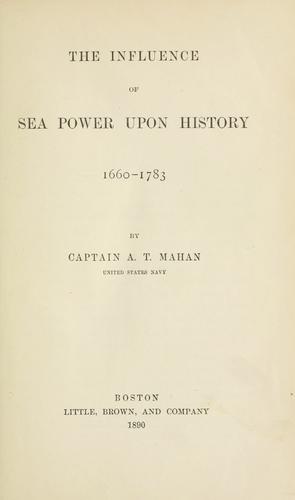
The Influence of Sea Power Upon History, 1660-1783Mahan, A. T. (Alfred Thayer)
History
The Influence of Sea Power Upon History, 1660-1783
Mahan, A. T. (Alfred Thayer)
Naval history, Modern; Sea-power
The following year the same strategic and political mistake was made.
It is the nature of an enterprise such as James's, dependent upon a
weaker people and foreign help, to lose strength if it does not
progress; but the chances were still in his favor, provided France
co-operated heartily, and above all, with her fleet. It is equally the
nature of a merely military navy like that of France to be strongest
at the beginning of hostilities; whereas that of the allied sea powers
grew daily stronger, drawing upon the vast resources of their merchant
shipping and their wealth. The disparity of force was still in favor
of France in 1690, but it was not as great as the year before. The
all-important question was where to direct it. There were two
principal courses, involving two views of naval strategy. The one was
to act against the allied fleet, whose defeat, if sufficiently severe,
might involve the fall of William's throne in England; the other was
to make the fleet subsidiary to the Irish campaign. The French king
decided upon the former, which was undoubtedly the proper course; but
there was no reason for neglecting, as he did, the important duty of
cutting off the communications between the two islands. As early as
March he had sent a large fleet with six thousand troops and supplies
of war, which were landed without any trouble in the southern ports of
Ireland; but after performing that service, the ships employed
returned to Brest, and there remained inactive during May and June
while the grand fleet under the Comte de Tourville was assembling.
During those two months the English were gathering an army on their
west coast, and on the 21st of June, William embarked his forces at
Chester on board two hundred and eighty-eight transports, escorted by
only six men-of-war. On the 24th he landed in Carrickfergus, and the
ships-of-war were dismissed to join the English grand fleet, which,
however, they were not able to do; Tourville's ships having in the
mean time got to sea and occupied the channel to the eastward. There
is nothing more striking than the carelessness shown by both the
contending parties, during the time that Ireland was in dispute, as to
the communications of their opponents with the island; but this was
especially strange in the French, as they had the larger forces, and
must have received pretty accurate information of what was going on
from disaffected persons in England. It appears that a squadron of
twenty-five frigates, to be supported by ships-of-the-line, were told
off for duty in St. George's Channel; but they never reached their
station, and only ten of the frigates had got as far as Kinsale by the
time James had lost all at the battle of the Boyne. The English
communications were not even threatened for an hour.
Public-domain text, read in full here on John Shaqi.
Reviews
Reviews
No reviews yet
Be the first to share your thoughts on this work.
Elsewhere in the archive
Join the Discussion
Join the discussion
Sign in to leave a comment or review.
Sign InorCreate an account