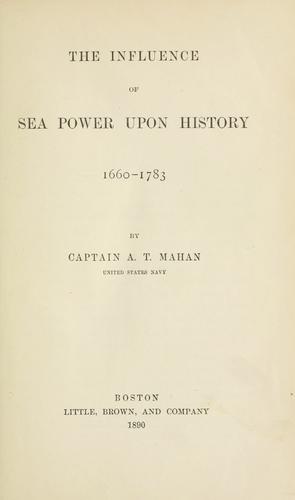
The Influence of Sea Power Upon History, 1660-1783Mahan, A. T. (Alfred Thayer)
History
The Influence of Sea Power Upon History, 1660-1783
Mahan, A. T. (Alfred Thayer)
Naval history, Modern; Sea-power
Having amply vindicated the honor of his fleet, and shown the
uselessness of further fighting, Tourville now thought of retreat,
which was begun at midnight with a light northeast wind and continued
all the next day. The allies pursued, the movements of the French
being much embarrassed by the crippled condition of the flag-ship
"Royal Sun," the finest ship in the French navy, which the admiral
could not make up his mind to destroy. The direction of the main
retreat was toward the Channel Islands, thirty-five ships being with
the admiral; of them twenty passed with the tidal current through the
dangerous passage known as the Race of Alderney, between the island of
that name and the mainland, and got safe to St. Malo. Before the
remaining fifteen could follow, the tide changed; and the anchors
which had been dropped dragging, these ships were carried to the
eastward and to leeward of the enemy. Three sought refuge in
Cherbourg, which had then neither breakwater nor port, the remaining
twelve at Cape La Hougue; and they were all burned either by their own
crews or by the allies. The French thus lost fifteen of the finest
ships in their navy, the least of which carried sixty guns; but this
was little more than the loss of the allies at Beachy Head. The
impression made upon the public mind, accustomed to the glories and
successes of Louis XIV., was out of all proportion to the results, and
blotted out the memory of the splendid self-devotion of Tourville and
his followers. La Hougue was also the last general action fought by
the French fleet, which did rapidly dwindle away in the following
years, so that this disaster seemed to be its death-blow. As a matter
of fact, however, Tourville went to sea the next year with seventy
ships, and the losses were at the time repaired. The decay of the
French navy was not due to any one defeat, but to the exhaustion of
France and the great cost of the continental war; and this war was
mainly sustained by the two sea peoples whose union was secured by the
success of William in the Irish campaign. Without asserting that the
result would have been different had the naval operations of France
been otherwise directed in 1690, it may safely be said that their
misdirection was the immediate cause of things turning out as they
did, and the first cause of the decay of the French navy.
The five remaining years of the War of the League of Augsburg, in
which all Europe was in arms against France, are marked by no great
sea battles, nor any single maritime event of the first importance. To
appreciate the effect of the sea power of the allies, it is necessary
to sum up and condense an account of the quiet, steady pressure which
it brought to bear and maintained in all quarters against France. It
is thus indeed that sea power usually acts, and just because so quiet
in its working, it is the more likely to be unnoticed and must be
somewhat carefully pointed out.
Public-domain text, read in full here on John Shaqi.
Reviews
Reviews
No reviews yet
Be the first to share your thoughts on this work.
Elsewhere in the archive
Join the Discussion
Join the discussion
Sign in to leave a comment or review.
Sign InorCreate an account