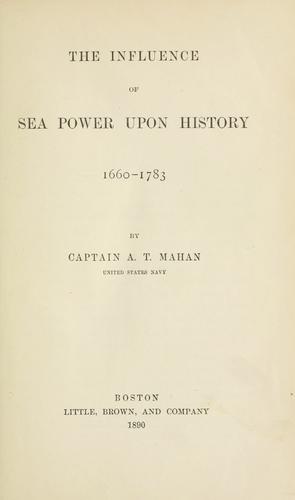
The Influence of Sea Power Upon History, 1660-1783Mahan, A. T. (Alfred Thayer)
History
The Influence of Sea Power Upon History, 1660-1783
Mahan, A. T. (Alfred Thayer)
Naval history, Modern; Sea-power
return for the use of the ships. Such employment would be demoralizing
to any military service, but not necessarily all at once; and the
conditions imparted for the time a tone and energy to privateering
that it cannot always have. In truth, the public treasury, not being
able to maintain the navy, associated with itself private capital,
risking only material otherwise useless, and looking for returns to
robbing the enemy. The commerce-destroying of this war, also, was no
mere business of single cruisers; squadrons of three or four up to
half a dozen ships acted together under one man, and it is only just
to say that under seamen like Jean Bart, Forbin, and Duguay-Trouin,
they were even more ready to fight than to pillage. The largest of
these private expeditions, and the only one that went far from the
French shores, was directed in 1697 against Cartagena, on the Spanish
Main. It numbered seven ships-of-the-line and six frigates, besides
smaller vessels, and carried twenty-eight hundred troops. The chief
object was to lay a contribution on the city of Cartagena; but its
effect on the policy of Spain was marked, and led to peace. Such a
temper and concert of action went far to supply the place of
supporting fleets, but could not wholly do so; and although the allies
continued to keep their large fleets together, still, as the war went
on and efficiency of administration improved, commerce-destroying was
brought within bounds. At the same time, as an evidence of how much
the unsupported cruisers suffered, even under these favorable
conditions, it may be mentioned that the English report fifty-nine
ships-of-war captured against eighteen admitted by the French during
the war,--a difference which a French naval historian attributes, with
much probability, to the English failing to distinguish between
ships-of-war properly so called, and those loaned to private firms.
Captures of actual privateers do not appear in the list quoted from.
"The commerce-destroying of this war, therefore, was marked by the
particular characteristics of cruisers acting together in squadron,
not far from their base, while the enemy thought best to keep his
fleet concentrated elsewhere; notwithstanding which, and the bad
administration of the English navy, the cruisers were more and more
controlled as the great French fleets disappeared." The results of the
war of 1689-1697 do not therefore vitiate the general conclusion that
"a cruising, commerce-destroying warfare, to be destructive, must be
seconded by a squadron warfare, and by divisions of ships-of-the-line;
which, forcing the enemy to unite his forces, permit the cruisers to
make fortunate attempts upon his trade. Without such backing the
result will be simply the capture of the cruisers." Toward the end of
this war the real tendency was becoming manifest, and was still more
plainly seen in the next, when the French navy had sunk to a yet lower
state of weakness.
Public-domain text, read in full here on John Shaqi.
Reviews
Reviews
No reviews yet
Be the first to share your thoughts on this work.
Elsewhere in the archive
Join the Discussion
Join the discussion
Sign in to leave a comment or review.
Sign InorCreate an account