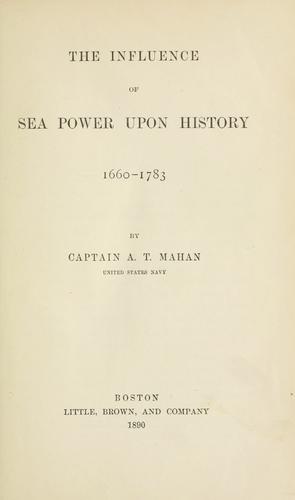
The Influence of Sea Power Upon History, 1660-1783Mahan, A. T. (Alfred Thayer)
History
The Influence of Sea Power Upon History, 1660-1783
Mahan, A. T. (Alfred Thayer)
Naval history, Modern; Sea-power
Notwithstanding their losses, the sea nations made good their cause.
The war, which began with the French taking the offensive, ended by
reducing them everywhere to the defensive, and forced Louis to do
violence at once to his strongest prejudices and his most reasonable
political wishes, by recognizing as king of England him whom he looked
upon as a usurper as well as his own inveterate enemy. On its
surface, and taken as a whole, this war will appear almost wholly a
land struggle, extending from the Spanish Netherlands down the line of
the Rhine, to Savoy in Italy and Catalonia in Spain. The sea fights in
the Channel, the Irish struggle receding in the distance, look like
mere episodes; while the underlying action of trade and commerce is
wholly disregarded, or noticed only as their outcries tell of their
sufferings. Yet trade and shipping not only bore the burden of
suffering, but in the main paid the armies that were fighting the
French; and this turning of the stream of wealth from both sea nations
into the coffers of their allies was perhaps determined, certainly
hastened, by the misdirection of that naval supremacy with which
France began the war. It was then possible, as it will usually be
possible, for a really fine military navy of superior force to strike
an overwhelming blow at a less ready rival; but the opportunity was
allowed to slip, and the essentially stronger, better founded sea
power of the allies had time to assert itself.
The peace signed at Ryswick in 1697 was most disadvantageous to
France; she lost all that had been gained since the Peace of Nimeguen,
nineteen years before, with the single important exception of
Strasburg. All that Louis XIV. had gained by trick or force during the
years of peace was given up. Immense restitutions were made to Germany
and to Spain. In so far as the latter were made in the Netherlands,
they were to the immediate advantage of the United Provinces, and
indeed of all Europe as well as of Spain. To the two sea nations the
terms of the treaty gave commercial benefits, which tended to the
increase of their own sea power and to the consequent injury of that
of France.
France had made a gigantic struggle; to stand alone as she did then,
and as she has since done more than once, against all Europe is a
great feat. Yet it may be said that as the United Provinces taught the
lesson that a nation, however active and enterprising, cannot rest
upon external resources alone, if intrinsically weak in numbers and
territory, so France in its measure shows that a nation cannot
subsist indefinitely off itself, however powerful in numbers and
strong in internal resources.
Public-domain text, read in full here on John Shaqi.
Reviews
Reviews
No reviews yet
Be the first to share your thoughts on this work.
Elsewhere in the archive
Join the Discussion
Join the discussion
Sign in to leave a comment or review.
Sign InorCreate an account