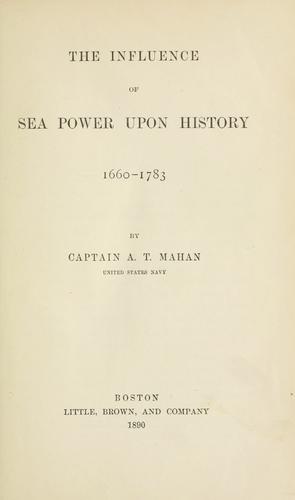
The Influence of Sea Power Upon History, 1660-1783Mahan, A. T. (Alfred Thayer)
History
The Influence of Sea Power Upon History, 1660-1783
Mahan, A. T. (Alfred Thayer)
Naval history, Modern; Sea-power
It is necessary to recall the various countries that were ruled by
Spain at that time in order to understand the strategic questions, as
they may fairly be called, now to be settled. These were, in Europe,
the Netherlands (now Belgium); Naples and the south of Italy; Milan
and other provinces in the north; and, in the Mediterranean, Sicily,
Sardinia, and the Balearic Isles. Corsica at that time belonged to
Genoa. In the western hemisphere, besides Cuba and Porto Rico, Spain
then held all that part of the continent now divided among the
Spanish American States, a region whose vast commercial possibilities
were coming to be understood; and in the Asian archipelago there were
large possessions that entered less into the present dispute. The
excessive weakness of this empire, owing to the decay of the central
kingdom, had hitherto caused other nations, occupied as they were with
more immediate interests, to regard with indifference its enormous
extent. This indifference could not last when there was a prospect of
a stronger administration, backed possibly by alliances with one of
the great powers of Europe.
It would be foreign to our subject to enter into the details of
diplomatic arrangement, which, by shifting about peoples and
territories from one ruler to another, sought to reach a political
balance peacefully. The cardinal points of each nation's policy may be
shortly stated. The Spanish cabinet and people objected to any
solution which dismembered the empire. The English and the Dutch
objected to any extension of France in the Spanish Netherlands, and to
the monopoly by the French of the trade with Spanish America, both
which they feared as the results of placing a Bourbon on the Spanish
throne. Louis XIV. wanted Naples and Sicily for one of his sons, in
case of any partition; thus giving France a strong Mediterranean
position, but one which would be at the mercy of the sea powers,--a
fact which induced William III. to acquiesce in this demand. The
Emperor of Austria particularly objected to these Mediterranean
positions going away from his family, and refused to come into any of
the partition treaties. Before any arrangement was perfected, the
actual king of Spain died, but before his death was induced by his
ministers to sign a will, bequeathing all his States to the grandson
of Louis XIV., then Duke of Anjou, known afterward as Philip V. of
Spain. By this step it was hoped to preserve the whole, by enlisting
in its defence the nearest and one of the most powerful States in
Europe,--nearest, if are excepted the powers ruling the sea, which are
always near any country whose ports are open to their ships.
Public-domain text, read in full here on John Shaqi.
Reviews
Reviews
No reviews yet
Be the first to share your thoughts on this work.
Elsewhere in the archive
Join the Discussion
Join the discussion
Sign in to leave a comment or review.
Sign InorCreate an account