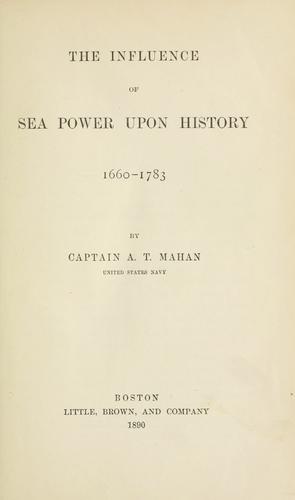
The Influence of Sea Power Upon History, 1660-1783Mahan, A. T. (Alfred Thayer)
History
The Influence of Sea Power Upon History, 1660-1783
Mahan, A. T. (Alfred Thayer)
Naval history, Modern; Sea-power
[72] Seignelay, the French minister of marine of the day, called him
"poltron de tête, mais pas de coeur."
[73] The author has followed in the text the traditional and generally
accepted account of Tourville's orders and the motives of his action.
A French writer, M. de Crisenoy, in a very interesting paper upon the
secret history preceding and accompanying the event, traverses many of
these traditional statements. According to him, Louis XIV. was not
under any illusion as to the loyalty of the English officers to their
flag; and the instructions given to Tourville, while peremptory under
certain conditions, did not compel him to fight in the situation of
the French fleet on the day of the battle. The tone of the
instructions, however, implied dissatisfaction with the admiral's
action in previous cruises, probably in the pursuit after Beachy Head,
and a consequent doubt of his vigor in the campaign then beginning.
Mortification therefore impelled him to the desperate attack on the
allied fleet; and, according to M. de Crisenoy, the council of war in
the admiral's cabin, and the dramatic production of the king's orders,
had no existence in fact.
[74] Campbell: Lives of the Admirals.
CHAPTER V.
WAR OF THE SPANISH SUCCESSION, 1702-1713.--SEA BATTLE OF MALAGA.
During the last thirty years of the seventeenth century, amid all the
strifes of arms and diplomacy, there had been clearly foreseen the
coming of an event which would raise new and great issues. This was
the failure of the direct royal line in that branch of the House of
Austria which was then on the Spanish throne; and the issues to be
determined when the present king, infirm both in body and mind, should
die, were whether the new monarch was to be taken from the House of
Bourbon or from the Austrian family in Germany; and whether, in either
event, the sovereign thus raised to the throne should succeed to the
entire inheritance, the Empire of Spain, or some partition of that
vast inheritance be made in the interests of the balance of European
power. But this balance of power was no longer understood in the
narrow sense of continental possessions; the effect of the new
arrangements upon commerce, shipping, and the control both of the
ocean and the Mediterranean, was closely looked to. The influence of
the two sea powers and the nature of their interests were becoming
more evident.
Public-domain text, read in full here on John Shaqi.
Reviews
Reviews
No reviews yet
Be the first to share your thoughts on this work.
Elsewhere in the archive
Join the Discussion
Join the discussion
Sign in to leave a comment or review.
Sign InorCreate an account