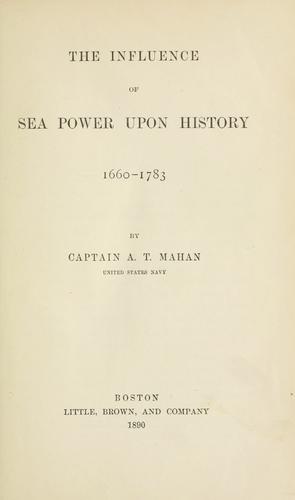
The Influence of Sea Power Upon History, 1660-1783Mahan, A. T. (Alfred Thayer)
History
The Influence of Sea Power Upon History, 1660-1783
Mahan, A. T. (Alfred Thayer)
Naval history, Modern; Sea-power
greater part of her threatened possessions. It was a gain to Holland
to be definitively freed from French aggression, with Belgium in the
hands of a strong instead of a weak State. And it doubtless was a gain
to Austria not only to have checked, chiefly at the expense of others,
the progress of her hereditary enemy, but also to have received
provinces like Sicily and Naples, which, under wise government, might
become the foundation of a respectable sea power. But not one of these
gains, nor all together, compared in greatness, and much less in
solidity, with the gain to England of that unequalled sea power which
started ahead during the War of the League of Augsburg, and received
its completeness and seal during that of the Spanish Succession. By it
she controlled the great commerce of the open sea with a military
shipping that had no rival, and in the exhausted condition of the
other nations could have none; and that shipping was now securely
based on strong positions in all the disputed quarters of the world.
Although her Indian empire was not yet begun, the vast superiority of
her navy would enable her to control the communications of other
nations with those rich and distant regions, and to assert her will in
any disputes arising among the trading-stations of the different
nationalities. The commerce which had sustained her in prosperity, and
her allies in military efficiency, during the war, though checked and
harassed by the enemy's cruisers (to which she could pay only partial
attention amid the many claims upon her), started with a bound into
new life when the war was over. All over the world, exhausted by their
share of the common suffering, people were longing for the return of
prosperity and peaceful commerce; and there was no country ready as
England was in wealth, capital, and shipping to forward and reap the
advantages of every enterprise by which the interchange of commodities
was promoted, either by lawful or unlawful means. In the War of the
Spanish Succession, by her own wise management and through the
exhaustion of other nations, not only her navy but her trade was
steadily built up; and indeed, in that dangerous condition of the
seas, traversed by some of the most reckless and restless cruisers
France ever sent out, the efficiency of the navy meant safer voyages,
and so more employment for the merchant-ships. The British
merchant-ships, being better protected than those of the Dutch, gained
the reputation of being far safer carriers, and the carrying-trade
naturally passed more and more into their hands; while the habit of
employing them in preference, once established, was likely to
continue.
Public-domain text, read in full here on John Shaqi.
Reviews
Reviews
No reviews yet
Be the first to share your thoughts on this work.
Elsewhere in the archive
Join the Discussion
Join the discussion
Sign in to leave a comment or review.
Sign InorCreate an account