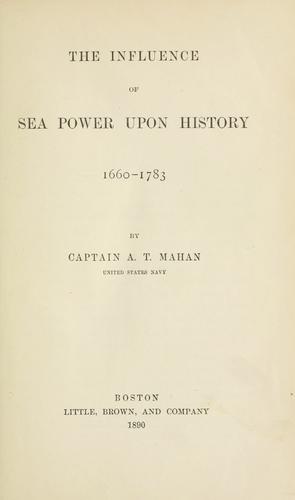
The Influence of Sea Power Upon History, 1660-1783Mahan, A. T. (Alfred Thayer)
History
The Influence of Sea Power Upon History, 1660-1783
Mahan, A. T. (Alfred Thayer)
Naval history, Modern; Sea-power
The gist of the situation created by these different aims and
feelings, was that the Emperor of Austria and the King of Spain both
wanted Sicily, which at Utrecht had been given to the Duke of Savoy;
and that France and England both wished for peace in western Europe,
because war would give an opportunity to the malcontents in either
kingdom. The position of George, however, being more secure than that
of Orleans, the policy of the latter tended to yield to that of the
former, and this tendency was increased by the active ill-will of the
King of Spain. George, as a German, wished the emperor's success; and
the English statesmen naturally preferred to see Sicily in the hands
of their late ally and well-assured friend rather than in Spain's.
France, contrary to her true policy, but under the urgency of the
regent's position, entertained the same views, and it was proposed to
modify the Treaty of Utrecht by transferring Sicily from Savoy to
Austria, giving the former Sardinia instead. It was necessary,
however, to consider Spain, which under Alberoni had already gained a
degree of military power astounding to those who had known her
weakness during the last war. She was not yet ready to fight, for only
half of the five years asked by the cardinal had passed; but still
less was she ready to forego her ambitions. A trifling incident
precipitated an outbreak. A high Spanish official, travelling from
Rome to Spain by land, and so passing through the Italian States of
the emperor, was arrested as a rebellious subject by order of the
latter, who still styled himself King of Spain. At this insult,
Alberoni could not hold Philip back. An expedition of twelve ships of
war and eighty-six hundred soldiers was sent against Sardinia, the
transfer to Savoy not having yet taken effect, and reduced the island
in a few months. This happened in 1717.
Public-domain text, read in full here on John Shaqi.
Reviews
Reviews
No reviews yet
Be the first to share your thoughts on this work.
Elsewhere in the archive
Join the Discussion
Join the discussion
Sign in to leave a comment or review.
Sign InorCreate an account