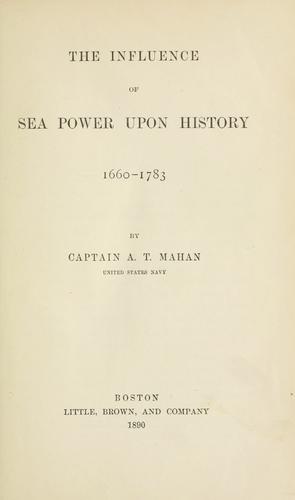
The Influence of Sea Power Upon History, 1660-1783Mahan, A. T. (Alfred Thayer)
History
The Influence of Sea Power Upon History, 1660-1783
Mahan, A. T. (Alfred Thayer)
Naval history, Modern; Sea-power
Doubtless the Spaniards would at once have moved on against Sicily;
but France and England now intervened more actively to prevent the
general war that seemed threatening. England sent a fleet to the
Mediterranean, and negotiations began at Paris, Vienna, and Madrid.
The outcome of these conferences was an agreement between England and
France to effect the exchange of Sardinia and Sicily just mentioned,
recompensing Spain by giving her Parma and Tuscany in northern Italy,
and stipulating that the emperor should renounce forever his absurd
but irritating claim to the Spanish crown. This arrangement was to be
enforced by arms, if necessary. The emperor at first refused consent;
but the increasing greatness of Alberoni's preparations at last
decided him to accept so advantageous an offer, and the accession of
Holland to the compact gave it the historical title of the Quadruple
Alliance. Spain was obstinate; and it is significant of Alberoni's
achievements in developing her power, and the eagerness, not to say
anxiety, of George I., that the offer was made to purchase her consent
by ceding Gibraltar. If the Regent Orleans knew this, it would partly
justify his forwarding the negotiations.
Alberoni tried to back up his military power by diplomatic efforts
extending all over Europe. Russia and Sweden were brought together in
a project for invading England in the interest of the Stuarts; the
signing of the Quadruple Alliance in Holland was delayed by his
agents; a conspiracy was started in France against the regent; the
Turks were stirred up against the emperor; discontent was fomented
throughout Great Britain; and an attempt was made to gain over the
Duke of Savoy, outraged by being deprived of Sicily. On the 1st of
July, 1718, a Spanish army of thirty thousand troops, escorted by
twenty-two ships-of-the-line, appeared at Palermo. The troops of Savoy
evacuated the city and pretty nearly the whole island, resistance
being concentrated in the citadel of Messina. Anxiety was felt in
Naples itself, until the English admiral, Byng,[80] anchored there the
day after the investment of Messina. The King of Sicily having now
consented to the terms of the Quadruple Alliance, Byng received on
board two thousand Austrian troops to be landed at Messina. When he
appeared before the place, finding it besieged, he wrote to the
Spanish general suggesting a suspension of arms for two months. This
was of course refused; so the Austrians were landed again at Reggio,
in Italy, and Byng passed through the Straits of Messina to seek the
Spanish fleet, which had gone to the southward.
Public-domain text, read in full here on John Shaqi.
Reviews
Reviews
No reviews yet
Be the first to share your thoughts on this work.
Elsewhere in the archive
Join the Discussion
Join the discussion
Sign in to leave a comment or review.
Sign InorCreate an account