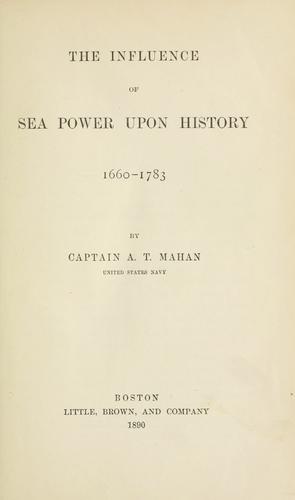
The Influence of Sea Power Upon History, 1660-1783Mahan, A. T. (Alfred Thayer)
History
The Influence of Sea Power Upon History, 1660-1783
Mahan, A. T. (Alfred Thayer)
Naval history, Modern; Sea-power
To use a common expression, this battle, the first general action
since that off Malaga forty years before, "woke up" the English people
and brought about a healthful reaction. The sifting process begun by
the battle itself was continued, but the result was reached too late
to have its proper effect on the current war. It is rather by its
deficient action, than by such conspicuous successes as were attained
in earlier and later times, that the general value of England's sea
power is now shown; like some precious faculty, scarcely valued when
possessed, but keenly missed when withdrawn. Mistress now of the seas
rather by the weakness of her enemies than by her own disciplined
strength, she drew from that mastery no adequate results; the most
solid success, the capture of Cape Breton Island, in 1745, was
achieved by the colonial forces of New England, to which indeed the
royal navy lent valuable aid, for to troops so situated the fleet is
the one line of communication. The misconduct off Toulon was repeated
by officers high in command in the West and East Indies, resulting in
the latter case in the loss of Madras. Other causes concurred with the
effete condition of the naval officers to hamper the action of that
sea power which launches out far from home. The condition of England
itself was insecure; the cause of the Stuarts was still alive, and
though a formidable invasion by fifteen thousand troops under Marshal
Saxe, in 1744, was foiled, partly by the English Channel fleet, and
partly by a storm which wrecked several of the transports assembled
off Dunkirk, with the loss of many lives, yet the reality of the
danger was shown in the following year, when the Pretender landed in
Scotland with only a few men at his back and the northern kingdom rose
with him. His successful invasion was carried well down into England
itself; and sober historians have thought that at one time the chances
of ultimate success were rather with than against him. Another serious
fetter upon the full use of England's power was the direction given to
the French operations on land and the mistaken means used to oppose
them. Neglecting Germany, France turned upon the Austrian Netherlands,
a country which England, out of regard to her sea interests, was not
willing to see conquered. Her commercial preponderance would be
directly threatened by the passing of Antwerp, Ostend, and the Scheldt
into the hands of her great rival; and though her best check against
this would have been to seize valuable French possessions elsewhere
and hold them as a pledge, the weakness of her government and the
present inefficiency of the navy prevented her doing so. The position
of Hanover, again, controlled the action of England; for though united
only by the tie of a common sovereign, the love of that sovereign for
his continental dominion, his native country, made itself strongly
felt in the councils of a weak and time-serving ministry. It was the
Public-domain text, read in full here on John Shaqi.
Reviews
Reviews
No reviews yet
Be the first to share your thoughts on this work.
Elsewhere in the archive
Join the Discussion
Join the discussion
Sign in to leave a comment or review.
Sign InorCreate an account