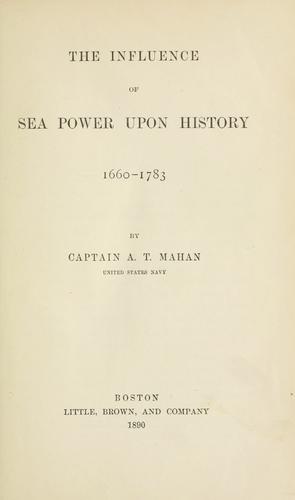
The Influence of Sea Power Upon History, 1660-1783Mahan, A. T. (Alfred Thayer)
History
The Influence of Sea Power Upon History, 1660-1783
Mahan, A. T. (Alfred Thayer)
Naval history, Modern; Sea-power
disregard of Hanover by the first William Pitt, consequent upon his
strong English feeling, that incensed the king and led him so long to
resist the demands of the nation that he should be put at the head of
affairs. These different causes--dissension at home, interest in the
Netherlands, regard for Hanover--combined to prevent a subservient and
second-rate ministry, divided also among themselves, from giving a
proper direction and infusing a proper spirit into the naval war; but
a better condition of the navy itself, more satisfactory results from
it, might have modified even their action. As it was, the outcome of
the war was almost nothing as regards the disputes between England and
her special enemies. On the continent, the questions after 1745
reduced themselves to two,--what part of the Austrian possessions
should be given to Prussia, Spain, and Sardinia, and how peace was to
be wrenched by France from England and Holland. The sea countries
still, as of old, bore the expenses of the war, which however now fell
chiefly upon England. Marshal Saxe, who commanded the French in
Flanders throughout this war, summed up the situation in half a dozen
words to his king. "Sire," said he, "peace is within the walls of
Maestricht." This strong city opened the course of the Meuse and the
way for the French army into the United Provinces from the rear; for
the English fleet, in conjunction with that of Holland, prevented an
attack from the sea. By the end of 1746, despite the efforts of the
allies, nearly all Belgium was in the hands of the French; but up to
this time, although Dutch subsidies were supporting the Austrian
government, and Dutch troops in the Netherlands were fighting for it,
there was nominal peace between the United Provinces and France. In
April, 1747, "the King of France invaded Dutch Flanders, announcing
that he was obliged to send his army into the territory of the
republic, to arrest the protection granted by the States-General to
the Austrian and English troops; but that he had no intention of
breaking with it, and that the places and provinces occupied would be
restored to the United Provinces as soon as they gave proof that they
had ceased to succor the enemies of France." This was actual, but not
formal, war. Numerous places fell during the year, and the successes
of the French inclined both Holland and England to come to terms.
Negotiations went on during the winter; but in April, 1748, Saxe
invested Maestricht. This forced a peace.
Public-domain text, read in full here on John Shaqi.
Reviews
Reviews
No reviews yet
Be the first to share your thoughts on this work.
Elsewhere in the archive
Join the Discussion
Join the discussion
Sign in to leave a comment or review.
Sign InorCreate an account