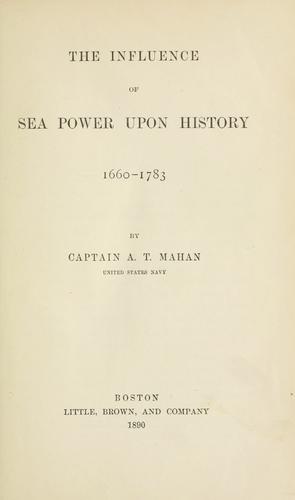
The Influence of Sea Power Upon History, 1660-1783Mahan, A. T. (Alfred Thayer)
History
The Influence of Sea Power Upon History, 1660-1783
Mahan, A. T. (Alfred Thayer)
Naval history, Modern; Sea-power
on the 2d of November the British ambassador announced to his
government that "two ships had safely arrived with very extraordinary
rich cargoes from the West Indies, so that all the wealth that was
expected from Spanish America is now safe in old Spain," and in the
same despatch reports a surprising change in the words of the Spanish
minister, and the haughty language now used.[106] The grievences and
claims of Spain were urged peremptorily, and the quarrel grew so fast
that even the new English ministry, though ardently desiring peace,
recalled their ambassador before the end of the year, and declared war
on the 4th of January, 1762; thus adopting Pitt's policy, but too late
to reap the advantages at which he had aimed.
However, no such delay on the part of England could alter the
essential inequality, in strength and preparation, between the two
nations. The plans formed by Pitt were in the main adopted by his
successor, and carried out with a speed which the readiness of the
English navy permitted. On the 5th of March, Pocock, who had returned
from the East Indies, sailed from Portsmouth, convoying a fleet of
transports to act against Havana; in the West Indies he was reinforced
from the forces in that quarter, so that his command contained
nineteen ships-of-the-line besides smaller vessels, and ten thousand
soldiers.
In the previous January, the West India fleet, under the well-known
Rodney, had acted with the land forces in the reduction of Martinique,
the gem and tower of the French islands and the harbor of an extensive
privateering system. It is said that fourteen hundred English
merchantmen were taken during this war in the West Indian seas by
cruisers whose principal port was Fort Royal in Martinique. With this
necessary base fell also the privateering system resting upon it.
Martinique was surrendered February 12, and the loss of this chief
commercial and military centre was immediately followed by that of the
smaller islands, Grenada, Sta. Lucia, St. Vincent. By these
acquisitions the English colonies at Antigua, St. Kitts, and Nevis, as
well as the ships trading to those islands, were secured against the
enemy, the commerce of England received large additions, and all the
Lesser Antilles, or Windward Islands, became British possessions.
Public-domain text, read in full here on John Shaqi.
Reviews
Reviews
No reviews yet
Be the first to share your thoughts on this work.
Elsewhere in the archive
Join the Discussion
Join the discussion
Sign in to leave a comment or review.
Sign InorCreate an account