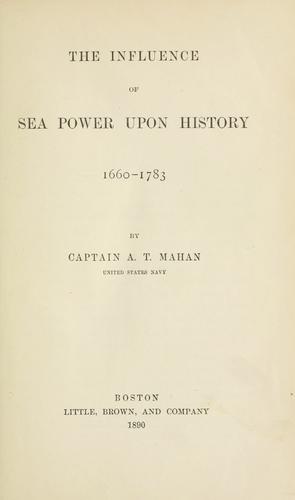
The Influence of Sea Power Upon History, 1660-1783Mahan, A. T. (Alfred Thayer)
History
The Influence of Sea Power Upon History, 1660-1783
Mahan, A. T. (Alfred Thayer)
Naval history, Modern; Sea-power
Admiral Pocock was joined off Cape St. Nicholas by the West Indian
reinforcement on the 27th of May, and as the season was so far
advanced, he took his great fleet through the old Bahama channel
instead of the usual route around the south side of Cuba. This was
justly considered a great feat in those days of poor surveys, and was
accomplished without an accident. Lookout and sounding vessels went
first, frigates followed, and boats or sloops were anchored on shoals
with carefully arranged signals for day or night. Having good weather,
the fleet got through in a week and appeared before Havana. The
operations will not be given in detail. After a forty days' siege the
Moro Castle was taken on the 30th of July, and the city surrendered on
the 10th of August. The Spaniards lost not only the city and port, but
twelve ships-of-the-line, besides £3,000,000 in money and merchandise
belonging to the Spanish king. The importance of Havana was not to be
measured only by its own size, or its position as centre of a large
and richly cultivated district; it was also the port commanding the
only passage by which the treasure and other ships could sail from the
Gulf of Mexico to Europe in those days. With Havana in an enemy's
hands it would be necessary to assemble them at Cartagena and from
there beat up against the trade-winds,--an operation always difficult,
and which would keep ships long in waters where they were exposed to
capture by English cruisers. Not even an attack upon the isthmus would
have been so serious a blow to Spain. This important result could only
be achieved by a nation confident of controlling the communications by
its sea power, to which the happy issue must wholly be ascribed, and
which had another signal illustration in the timely conveying of four
thousand American troops to reinforce the English ranks, terribly
wasted by battle and fever. It is said that only twenty-five hundred
serviceable fighting men remained on foot when the city fell.
Public-domain text, read in full here on John Shaqi.
Reviews
Reviews
No reviews yet
Be the first to share your thoughts on this work.
Elsewhere in the archive
Join the Discussion
Join the discussion
Sign in to leave a comment or review.
Sign InorCreate an account