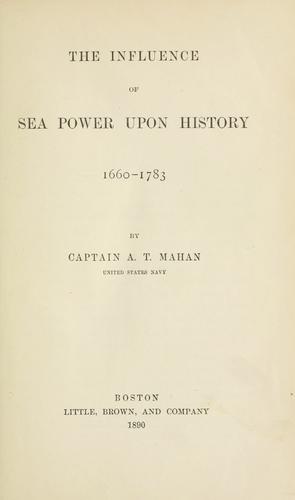
The Influence of Sea Power Upon History, 1660-1783Mahan, A. T. (Alfred Thayer)
History
The Influence of Sea Power Upon History, 1660-1783
Mahan, A. T. (Alfred Thayer)
Naval history, Modern; Sea-power
The date taken, 1660, followed closely another which marked a great
settlement of European affairs, setting the seal of treaty upon the
results of a general war, known to history as the Thirty Years' War.
This other date was that of the Treaty of Westphalia, or Munster, in
1648. In this the independence of the Dutch United Provinces, long
before practically assured, was formally acknowledged by Spain; and it
being followed in 1659 by the Treaty of the Pyrenees between France
and Spain, the two gave to Europe a state of general external peace,
destined soon to be followed by a series of almost universal wars,
which lasted as long as Louis XIV. lived,--wars which were to induce
profound changes in the map of Europe; during which new States were to
arise, others to decay, and all to undergo large modifications, either
in extent of dominion or in political power. In these results maritime
power, directly or indirectly, had a great share.
We must first look at the general condition of European States at the
time from which the narrative starts. In the struggles, extending over
nearly a century, whose end is marked by the Peace of Westphalia, the
royal family known as the House of Austria had been the great
overwhelming power which all others feared. During the long reign of
the Emperor Charles V., who abdicated a century before, the head of
that house had united in his own person the two crowns of Austria and
Spain, which carried with them, among other possessions, the countries
we now know as Holland and Belgium, together with a preponderating
influence in Italy. After his abdication the two great monarchies of
Austria and Spain were separated; but though ruled by different
persons, they were still in the same family, and tended toward that
unity of aim and sympathy which marked dynastic connections in that
and the following century. To this bond of union was added that of a
common religion. During the century before the Peace of Westphalia,
the extension of family power, and the extension of the religion
professed, were the two strongest motives of political action. This
was the period of the great religious wars which arrayed nation
against nation, principality against principality, and often, in the
same nation, faction against faction. Religious persecution caused the
revolt of the Protestant Dutch Provinces against Spain, which issued,
after eighty years of more or less constant war, in the recognition of
their independence. Religious discord, amounting to civil war at
times, distracted France during the greater part of the same period,
profoundly affecting not only her internal but her external policy.
These were the days of St. Bartholomew, of the religious murder of
Henry IV., of the siege of La Rochelle, of constant intriguing between
Roman Catholic Spain and Roman Catholic Frenchmen. As the religious
motive, acting in a sphere to which it did not naturally belong, and
in which it had no rightful place, died away, the political
Public-domain text, read in full here on John Shaqi.
Reviews
Reviews
No reviews yet
Be the first to share your thoughts on this work.
Elsewhere in the archive
Join the Discussion
Join the discussion
Sign in to leave a comment or review.
Sign InorCreate an account