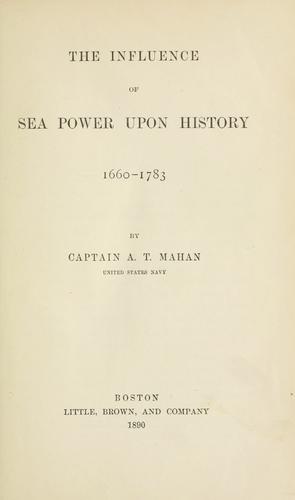
The Influence of Sea Power Upon History, 1660-1783Mahan, A. T. (Alfred Thayer)
History
The Influence of Sea Power Upon History, 1660-1783
Mahan, A. T. (Alfred Thayer)
Naval history, Modern; Sea-power
necessities and interests of States began to have juster weight; not
that they had been wholly lost sight of in the mean time, but the
religious animosities had either blinded the eyes, or fettered the
action, of statesmen. It was natural that in France, one of the
greatest sufferers from religious passions, owing to the number and
character of the Protestant minority, this reaction should first and
most markedly be seen. Placed between Spain and the German States,
among which Austria stood foremost without a rival, internal union and
checks upon the power of the House of Austria were necessities of
political existence. Happily, Providence raised up to her in close
succession two great rulers, Henry IV. and Richelieu,--men in whom
religion fell short of bigotry, and who, when forced to recognize it
in the sphere of politics, did so as masters and not as slaves. Under
them French statesmanship received a guidance, which Richelieu
formulated as a tradition, and which moved on the following general
lines,--(1) Internal union of the kingdom, appeasing or putting down
religious strife and centralizing authority in the king; (2)
Resistance to the power of the House of Austria, which actually and
necessarily carried with it alliance with Protestant German States and
with Holland; (3) Extension of the boundaries of France to the
eastward, at the expense mainly of Spain, which then possessed not
only the present Belgium, but other provinces long since incorporated
with France; and (4) The creation and development of a great sea
power, adding to the wealth of the kingdom, and intended specially to
make head against France's hereditary enemy, England; for which end
again the alliance with Holland was to be kept in view. Such were the
broad outlines of policy laid down by statesmen in the front rank of
genius for the guidance of that country whose people have, not without
cause, claimed to be the most complete exponent of European
civilization, foremost in the march of progress, combining political
advance with individual development. This tradition, carried on by
Mazarin, was received from him by Louis XIV.; it will be seen how far
he was faithful to it, and what were the results to France of his
action. Meanwhile it may be noted that of these four elements
necessary to the greatness of France, sea power was one; and as the
second and third were practically one in the means employed, it may be
said that sea power was one of the two great means by which France's
_external_ greatness was to be maintained. England on the sea, Austria
on the land, indicated the direction that French effort was to take.
Public-domain text, read in full here on John Shaqi.
Reviews
Reviews
No reviews yet
Be the first to share your thoughts on this work.
Elsewhere in the archive
Join the Discussion
Join the discussion
Sign in to leave a comment or review.
Sign InorCreate an account