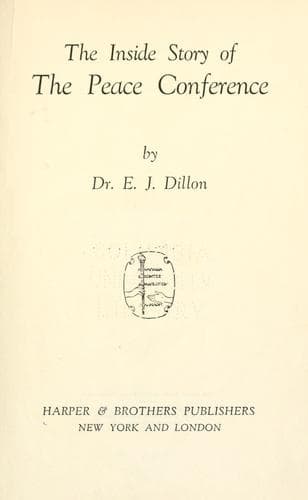
The Inside Story of the Peace ConferenceDillon, Emile Joseph
History
The Inside Story of the Peace Conference
Dillon, Emile Joseph
Paris Peace Conference (1919-1920)
About March 19th the Inter-Allied commission gave Erzberger twenty-four
hours in which to ratify the convention between Germany and Poland and
to carry out the conditions of the armistice. But Erzberger declined to
ratify it and the Allies were unable or unwilling to impose their will
on him. From this state of things the Rumanian delegates drew the
obvious corollary. Exasperated by the treatment they received, they
quitted the Conference, pursued their own policy, occupied Budapest,
presented their own peace conditions to Hungary, and relegated, with
courteous phrases and a polite bow to the Council, the directions
elaborated for their guidance to the region of pious counsels.
In these ways the well-meant and well-advertised endeavors to substitute
a moral relationship of nations for the state of latent warfare known as
the balance of power were steadily wasted. On the one side the subtle
skill of Old World diplomacy was toiling hard and successfully to revive
under specious names its lost and failing causes, while on the other
hand the New World policy, naïvely ignoring historical forces and
secular prejudices, was boldly reaching out toward rough and ready modes
of arranging things and taking no account of concrete circumstances.
Generous idealists were thus pitted against old diplomatic stagers and
both secretly strove to conclude hastily driven bargains outside the
Council chamber with their opponents. As early as the first days of
January I was present at some informal meetings where such transactions
were being talked over, and I afterward gave it as my impression that
"if things go forward as they are moving to-day the outcome will fall
far short of reasonable expectations. The first striking difference
between the transatlantic idealists and the Old World politicians lies
in their different ways of appreciating expeditiousness, on the one
hand, and the bases of the European state-system, on the other hand. A
statesman when dealing with urgent, especially revolutionary,
emergencies should never take his eyes from the clock. The politicians
in Paris hardly ever take account of time or opportunity. The overseas
reformers contend that the territorial and political balance of forces
has utterly broken down and must be definitely scrapped in favor of a
league of nations, and the diplomatists hold that the principle of
equilibrium, far from having spent its force, still affords the only
groundwork of international stability and requires to be further
intensified."[104]
Public-domain text, read in full here on John Shaqi.
Reviews
Reviews
No reviews yet
Be the first to share your thoughts on this work.
Elsewhere in the archive
Join the Discussion
Join the discussion
Sign in to leave a comment or review.
Sign InorCreate an account