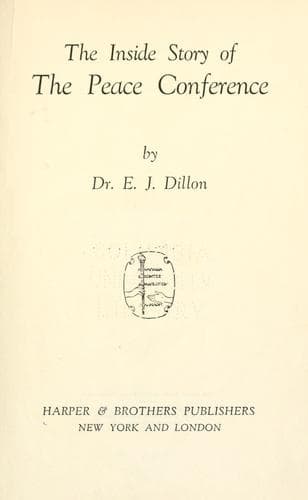
The Inside Story of the Peace ConferenceDillon, Emile Joseph
History
The Inside Story of the Peace Conference
Dillon, Emile Joseph
Paris Peace Conference (1919-1920)
Another delegate remarked: "Many years have elapsed since I passed my
last examination, but it came back to me in all its vividness when I
walked up to Premier Clemenceau and looked into his restless, flashing
eyes. I said to myself: When last I was examined I was painfully
conscious that my professors knew a lot more about the subject than I
did, but now I am painfully aware that they know hardly anything at all
and I am fervently desirous of teaching them. The task is arduous. It
might, however, save time and labor if the delegates would receive our
typewritten dissertations, read them quietly in their respective hotels,
and endeavor to form a judgment on the data they supply. Failing that,
I should like at least to provide them with a criterion of truth, for
after me will come an opponent who will flatly contradict me, and how
can they sift truth from error when the winnow is wanting? It is hard to
feel that one is in the presence of great satraps of destiny, but I made
an act of faith in the possibilities of genial quantities lurking behind
those everyday faces and of a sort of magic power of calling into being
new relations of peace and fellowship between individual classes and
peoples. It was an act of faith."
If the members of the Supreme Council lacked the graces with which to
draw their humbler colleagues and were incapable of according
hospitality to any of the more or less revolutionary ideas floating in
the air, they were also utterly powerless to enforce their behests in
eastern Europe against serious opposition. Thus, although they kept
considerable Inter-Allied forces in Germany, they failed to impose their
decrees there, notwithstanding the circumstance that Germany was
disorganized, nearly disarmed, and distracted by internal feuds. The
Conference gave way when Germany refused to let the Polish troops
disembark at Dantzig, although it had proclaimed its resolve to insist
on their using that port. It allowed Odessa to be evacuated and its
inhabitants to be decimated by the bloodthirsty Bolsheviki. It ordered
the Ukrainians and the Poles to cease hostilities,[103] but hostilities
went on for months afterward. An American general was despatched to the
warring peoples to put an end to the fighting, but he returned
despondent, leaving things as he had found them. General Smuts was sent
to Budapest to strike up an agreement with Kuhn and the Magyar
Bolshevists, but he, too, came back after a fruitless conversation. The
Supreme Council's writ ran in none of those places.
Public-domain text, read in full here on John Shaqi.
Reviews
Reviews
No reviews yet
Be the first to share your thoughts on this work.
Elsewhere in the archive
Join the Discussion
Join the discussion
Sign in to leave a comment or review.
Sign InorCreate an account