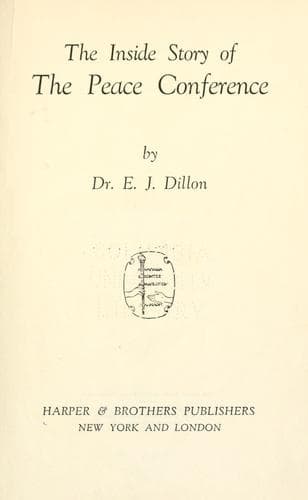
The Inside Story of the Peace ConferenceDillon, Emile Joseph
History
The Inside Story of the Peace Conference
Dillon, Emile Joseph
Paris Peace Conference (1919-1920)
It cannot be gainsaid that the two predominant partners behaved
throughout as benevolent despots, to whom despotism came more easily
than benevolence. As we saw, they kept their colleagues of the lesser
states as much in the dark as the general public and claimed from them
also implicit obedience to all their behests. They went farther and
demanded unreasoning acquiescence in decisions to be taken in the
future, and a promise of prompt acceptance of their injunctions--a
pretension such as was never before put forward outside the Catholic
Church, which, at any rate, claims infallibility. Asked why he had not
put up a better fight for one of the states of eastern Europe, a
sharp-tongued delegate irreverently made answer, "What more could you
expect than I did, seeing that I was opposed by one colleague who looks
upon himself as Napoleon and by another who believes himself to be the
Messiah."
Among the many epigrammatic sayings current in Paris about the
Conference, the most original was ascribed to the Emir Faissal, the son
of the King of the Hedjaz. Asked what he thought of the world's
areopagus, he is said to have answered: "It reminds me somewhat of one
of the sights of my own country. My country, as you know, is the desert.
Caravans pass through it that may be likened to the armies of delegates
and experts at the Conference--caravans of great camels solemnly
trudging along one after the other, each bearing its own load. They all
move not whither they will, but whither they are led. For they have no
choice. But between the two there is this difference: that whereas the
big caravan in the desert has but one leader--a little ass--the
Conference in Paris is led by two delegates who are the great Ones of
the earth." In effect, the leaders were two, and no one can say which
of them had the upper hand. Now it seemed to be the British Premier, now
the American President. The former scored the first victory, on the
freedom of the seas, before the Conference opened. The latter won the
next, when Mr. Wilson firmly insisted on inserting the Covenant in the
Treaty and finally overrode the objections of Mr. Lloyd George and M.
Clemenceau, who scouted the idea for a while as calculated to impair the
value of both charters. There was also a moment when the two were
reported to have had a serious disagreement and Mr. Lloyd George, having
suddenly quitted Paris for rustic seclusion, was likened to Achilles
sulking in his tent. But one of the two always gave way at the last
moment, just as both had given way to M. Clemenceau at the outset. When
the difference between Japan and China cropped up, for example, the
other delegates made Mr. Wilson their spokesman. Despite M. Clemenceau's
resolve that the public should not "be apprized that the head of one
government had ever put forward a proposal which was opposed by the head
of another government," it became known that they occasionally disagreed
Public-domain text, read in full here on John Shaqi.
Reviews
Reviews
No reviews yet
Be the first to share your thoughts on this work.
Elsewhere in the archive
Join the Discussion
Join the discussion
Sign in to leave a comment or review.
Sign InorCreate an account