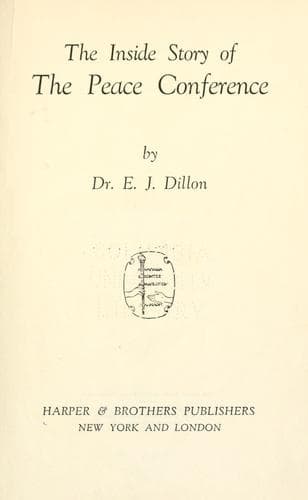
The Inside Story of the Peace ConferenceDillon, Emile Joseph
History
The Inside Story of the Peace Conference
Dillon, Emile Joseph
Paris Peace Conference (1919-1920)
among themselves, were more than once on the point of separating, and
that at best their unanimity was often of the verbal order, failing to
take root in identity of views. To those who would fain predicate
political tact or statesmanship of the men who thus undertook to set
human progress on a new and ethical basis, the story of these
bickerings, hasty improvisations, and amazing compromises is
distressing. The incertitude and suspense that resulted were
disconcerting. Nobody ever knew what was coming. A subcommission might
deliver a reasoned judgment on the question submitted to it, and this
might be unanimously confirmed by the commission, but the Four or Three
or Two or even One could not merely quash the report, but also reverse
the practical consequences that followed. This was done over and over
again.
And there were other performances still more amazing. When, for example,
the Polish problem became so pressing that it could not be safely
postponed any longer, the first delegates were at their wits' ends.
Unable to agree on any of the solutions mooted, they conceived the idea
of obtaining further data and a lead from a special commission. The
commission was accordingly appointed. Among its members were Sir Esmé
Howard, who has since become Ambassador in Rome, the American General
Kernan, and M. Noulens, the ex-Ambassador of France in Petrograd. These
envoys and their colleagues set out for Poland to study the problem on
the spot. They exerted themselves to the utmost to gather data for a
serious judgment, and returned to Paris after a sojourn of some two
months, legitimately proud of the copious and well-sifted results of
their research. And then they waited. Days passed and weeks, but nobody
took the slightest interest in the envoys. They were ignored. At last
the chief of the commission, M. Noulens, taking the initiative, wrote
direct to M. Clemenceau, informing him that the task intrusted to him
and his colleagues had been achieved, and requesting to be permitted to
make their report to the Conference. The reply was an order dissolving
the commission unheard.
Public-domain text, read in full here on John Shaqi.
Reviews
Reviews
No reviews yet
Be the first to share your thoughts on this work.
Elsewhere in the archive
Join the Discussion
Join the discussion
Sign in to leave a comment or review.
Sign InorCreate an account