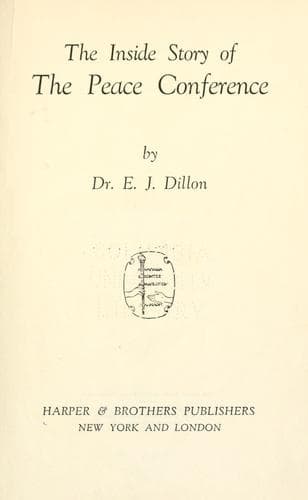
The Inside Story of the Peace ConferenceDillon, Emile Joseph
History
The Inside Story of the Peace Conference
Dillon, Emile Joseph
Paris Peace Conference (1919-1920)
Thus the grave reproach cannot be spared Mr. Wilson of having been weak,
vague, and inconsistent with himself. He constituted himself the supreme
judge of a series of intricate questions affecting the organization and
tranquillity of the European Continent, as he had previously done in the
case of Mexico, with the results we know. This authority was accorded to
him--with certain reservations--in virtue of the exalted position which
he held in a state disposing of vast financial and economic resources,
shielded from some of the dangers that continually overhang European
nations, and immune from the immediate consequences of the mistakes it
might commit in international politics. For every continental people in
Europe is in some measure dependent on the good-will of the United
States, and therefore anxious to deserve it by cultivating the most
friendly relations with its chief. This predisposition on the part of
his wards was an asset that could have been put to good account. It was
a guaranty of a measure of success which would have satisfied a generous
ambition; it would have enabled him to effect by a wise policy what
revolution threatened to accomplish by violence, and to canalize and
lead to fruitful fields the new-found strength of the proletarian
masses.
The compulsion of working with others is often a wholesome corrective.
It helps one to realize the need of accommodating measures to people's
needs. But Mr. Wilson deliberately segregated himself from the nations
for whose behoof he was laboring, and from some of their authorized
representatives. And yet the aspirations and conceptions of a large
section of the masses differed very considerably from those of the two
statesmen with whom he was in close collaboration. His avowed aims were
at the opposite pole to those of his colleagues. To reconcile
internationalism and nationalism was sheer impossible. Yet instead of
upholding his own, taking the peoples into his confidence, and sowing
the good seed which would certainly have sprouted up in the fullness of
time, he set himself, together with his colleagues, to weld
contradictories and contributed to produce a synthesis composed of
disembodied ideas, disintegrated communities, embittered nations,
conflicting states, frenzied classes, and a seething mass of discontent
throughout the world.
Public-domain text, read in full here on John Shaqi.
Reviews
Reviews
No reviews yet
Be the first to share your thoughts on this work.
Elsewhere in the archive
Join the Discussion
Join the discussion
Sign in to leave a comment or review.
Sign InorCreate an account