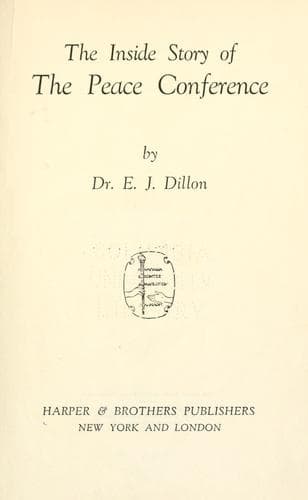
The Inside Story of the Peace ConferenceDillon, Emile Joseph
History
The Inside Story of the Peace Conference
Dillon, Emile Joseph
Paris Peace Conference (1919-1920)
Mr. Wilson has fared ill with his critics, who, when in quest of
explanations of his changeful courses, sought for them, as is the wont
of the average politician, in the least noble parts of human nature. In
his case they felt especially repelled by his imperial aloofness, the
secrecy of his deliberations, and the magisterial tone of his judgments,
even when these were in flagrant contradiction with one another.
Obstinacy was also included among the traits which were commonly
ascribed to him. As a matter of fact he was a very good listener, an
intelligent questioner, and amenable to argument whenever he felt free
to give practical effect to the conclusions. When this was not the case,
arguments necessarily failed of their effect, and on these occasions
considerations of expediency proved a lever sufficient to sway his
decision. But, like his more distinguished colleagues, he had to rely
upon counsel from outside, and in his case, as in theirs, the official
adviser was not always identical with the real prompter. He, too, as we
saw, set aside the findings of the commissions when they disagreed with
his own. In a word, Mr. Wilson's fatal stumble was to have sacrificed
essentials in order to score on issues of secondary moment; for while
success enabled him to obtain his paper Covenant from his co-delegates
in Paris, and to bring back tangible results to Washington, it lost him
the leadership of the world. The cost of this deplorable weakness to
mankind can be estimated only after its worst effects have been added up
and appraised.
In matters affecting the destinies of the lesser states Mr. Wilson was
firm as a rock. Prom the position once taken up nothing could move him.
Their economic dependence on his own country rendered their arguments
pointless and lent irresistible force to his injunctions. Greece's
dispute with Bulgaria was a classic instance. The Bulgars repaired to
Paris more as claimants in support of indefeasible rights than as
vanquished enemies summoned to learn the conditions imposed on them by
the nations which they had betrayed and assailed. Victory alone could
have justified their territorial pretensions; defeat made them
grotesque. All at once, however, it was bruited abroad that President
Wilson had become Bulgaria's intercessor and favored certain of her
exorbitant claims. One of these was for the annexation of part of the
coast of western Thrace, together with a seaport at the expense of the
Greeks, the race which had resided on the seaboard for twenty-five
hundred consecutive years. M. Venizelos offered them instead one
commercial outlet[118] and special privileges in another, and the
plenipotentiaries of Great Britain, France, and Japan considered the
offer adequate.
Public-domain text, read in full here on John Shaqi.
Reviews
Reviews
No reviews yet
Be the first to share your thoughts on this work.
Elsewhere in the archive
Join the Discussion
Join the discussion
Sign in to leave a comment or review.
Sign InorCreate an account