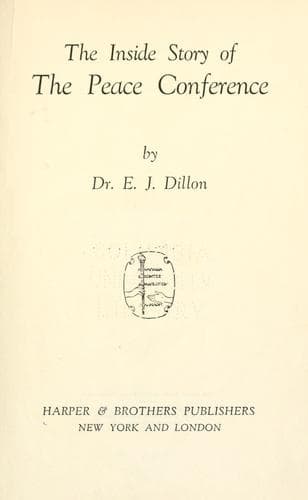
The Inside Story of the Peace ConferenceDillon, Emile Joseph
History
The Inside Story of the Peace Conference
Dillon, Emile Joseph
Paris Peace Conference (1919-1920)
The necessity of winning over dissentient colleagues to his grandiose
scheme of world reorganization and of satisfying their demands, which
were of a nature to render that scheme abortive, was the most
influential agency in impairing his energies and upsetting his plans.
This remark assumes what unhappily seems a fact, that those plans were
mainly mechanical. It is certain that they made no provision for
directly influencing the masses, for giving them sympathetic guidance,
and enabling them to suffuse with social sentiments the aspirations and
strivings which were chiefly of the materialistic order, with a view to
bringing about a spiritual transformation of the social basis. Indeed we
have no evidence that the need of such a transformation of the basis of
political thought, which was still rooted in the old order, was grasped
by any of those who set their hand to the legislative part of the work.
These unfavorable impressions were general. Almost every step
subsequently taken by the Conference confirmed them, and long before the
Treaty was presented to the Germans, public confidence was gone in the
ability of the Supreme Council to attain any of the moral victories over
militarism, race-hatred, and secret intrigues which its leaders had
encouraged the world to expect.
"The leaders of the Conference," wrote an influential press organ,[122]
"are under suspicion. They may not know it, but it is true. The
suspicion is doubtless unjust, but it exists. What exists is a fact; and
men who ignore facts are not statesmen. The only way to deal with facts
is to face them. The more unpleasant they are the more they need to be
faced.
"Some of the Conference leaders are suspected of having, at various
times and in various circumstances, thought more of their own personal
and political positions and ambitions than of the rapid and practical
making of peace. They are suspected, in a word, of a tendency to
subordinate policy to politics.
"In regard to some important matters they are suspected of having no
policy. They are also suspected of unwillingness to listen to their own
competent advisers, who could lay down for them a sound policy. Some of
them are even suspected of being under the spell of some benumbing
influence that paralyzes their will and befogs their minds, when high
resolve and clear visions are needful."
Another accusation of the same tenor was thus formulated: "In various
degrees[123] and with different qualities of guilt all the Allied and
Associated leaders have dallied with dishonesty. While professing to
seek naught save the welfare of mankind, they have harbored thoughts of
self-interest. The result has been a progressive loss of faith in them
by their own peoples severally, and by the Allied, Associated, and
neutral peoples jointly. The tide of public trust in them has reached
its lowest ebb."
Public-domain text, read in full here on John Shaqi.
Reviews
Reviews
No reviews yet
Be the first to share your thoughts on this work.
Elsewhere in the archive
Join the Discussion
Join the discussion
Sign in to leave a comment or review.
Sign InorCreate an account