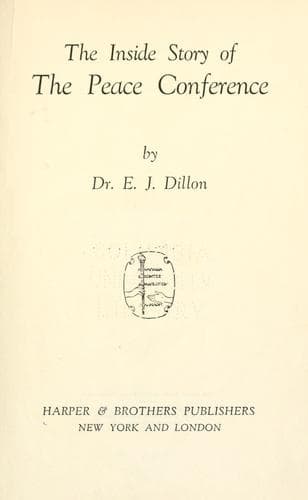
The Inside Story of the Peace ConferenceDillon, Emile Joseph
History
The Inside Story of the Peace Conference
Dillon, Emile Joseph
Paris Peace Conference (1919-1920)
M. Paderewski listened respectfully to the decree, and then remarked:
"According to the accounts received from the French military
authorities, Germany still has three hundred and fifty thousand soldiers
in Silesia." "No," corrected M. Clemenceau, "only three hundred
thousand." "I accept the correction," replied the Polish Premier. "The
difference, however, is of no importance to my contention, which is that
according to the symptoms reported we Poles may have to fight the
Germans and to wage the conflict single-handed. As you know, we have
other military work on hand. I need only mention our strife with the
Bolsheviki. If we are deprived of effective means of self-defense, on
the one hand, and told to expect no help from the Allies, on the other
hand, the consequence will be what every intelligent observer foresees.
Now three hundred thousand Germans is no trifle to cope with. If we
confront them with an inadequate force and are beaten, what then?"
"Undoubtedly," exclaimed M. Clemenceau, "if the Germans were victorious
in the east of Europe the Allies would have lost the war. And that is a
perspective not to be faced."
M. Bratiano spoke next. "We too," he said, "have to fight the Bolsheviki
on more than one front. This struggle is one of life and death to us.
But it concerns, if only in a lesser degree, all Europe, and we are
rendering services to the Great Powers by the sacrifices we thus offer
up. Is it desirable, is it politic, to limit our forces without
reference to these redoubtable tasks which await them? Is it not
incumbent on the Powers to allow these states to grow to the dimensions
required for the discharge of their functions?" "What you advance is
true enough for the moment," objected M. Clemenceau; "but you forget
that our limitations are not to be applied at once. We fix a term after
the expiry of which the strength of the armies will be reduced. We have
taken all the circumstances into account." "Are you prepared to affirm,"
queried the Rumanian Minister, "that you can estimate the time with
sufficient precision to warrant our risking the existence of our country
on your forecast?" "The danger will have completely disappeared,"
insisted the French Premier, "by January, 1921." "I am truly glad to
have this assurance," answered M. Bratiano, "for I doubt not that you
are quite certain of what you advance, else you would not stake the fate
of your eastern allies on its correctness. But as we who have not been
told the grounds on which you base this calculation are asked to
manifest our faith in it by incurring the heaviest conceivable risks,
would it be too much to suggest that the Great Powers should show their
confidence in their own forecast by guaranteeing that if by the
insurgence of unexpected events they proved to be mistaken and Rumania
were attacked, they would give us prompt and adequate military
assistance?" To this appeal there was no affirmative response; whereupon
M.
Public-domain text, read in full here on John Shaqi.
Reviews
Reviews
No reviews yet
Be the first to share your thoughts on this work.
Elsewhere in the archive
Join the Discussion
Join the discussion
Sign in to leave a comment or review.
Sign InorCreate an account