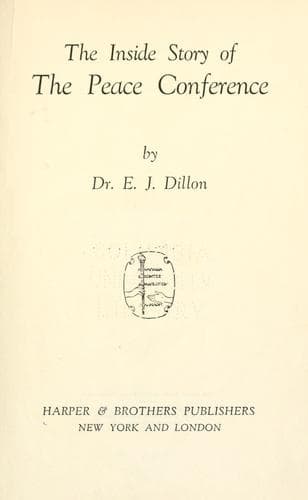
The Inside Story of the Peace ConferenceDillon, Emile Joseph
History
The Inside Story of the Peace Conference
Dillon, Emile Joseph
Paris Peace Conference (1919-1920)
The answer given by the "Rumanian government in Bucharest" to the
peremptory order of the Secret Council was a reasoned refusal to comply.
Rumania, taught by terrible experience, declined to be led once more
into deadly peril against her own better judgment. Her statesmen, more
intimately acquainted with the Hungarians than were Mr. Lloyd George,
Mr. Wilson, and M. Clemenceau, required guaranties which could be
supplied only by armed forces--Rumanian or Allied. Unless and until
Hungary received a government chosen by the free will of the people and
capable of offering guaranties of good conduct, the troops must remain
where they were. For the line which they occupied at the moment could be
defended with four divisions, whereas the new one could not be held by
less than seven or eight. The Council was therefore about to commit
another fateful mistake, the consequences of which it was certain to
shift to the shoulders of the pliant people. It was then that Rumania's
leaders kicked against the pricks.
To return to the dispute between Bucharest and Paris: the Rumanian
government would have been willing to conform to the desire of the
Supreme Council and withdraw its troops if the Supreme Council would
only make good its assurance and guarantee Rumania effectually from
future attacks by the Hungarians. The proviso was reasonable, and as a
measure of self-defense imperative. The safeguard asked for was a
contingent of Allied force. But the two supreme councilors in Paris
dealt only in counters. All they had to offer to M. Bratiano were verbal
exhortations before the combat and lip-sympathy after defeat, and these
the Premier rejected. But here, as in the case of the Poles, the
representatives of the "Allied and Associated" Powers insisted. They
were profuse of promises, exhortations, and entreaties before passing to
threats--of guaranties they said nothing--but the Rumanian Premier,
turning a deaf ear to cajolery and intimidation, remained inflexible.
For he was convinced that their advice was often vitiated by gross
ignorance and not always inspired by disinterestedness, while the orders
they issued were hardly more than the velleities of well-meaning gropers
in the dark who lacked the means of executing them.
Public-domain text, read in full here on John Shaqi.
Reviews
Reviews
No reviews yet
Be the first to share your thoughts on this work.
Elsewhere in the archive
Join the Discussion
Join the discussion
Sign in to leave a comment or review.
Sign InorCreate an account