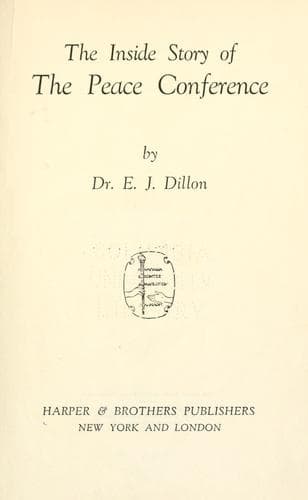
The Inside Story of the Peace ConferenceDillon, Emile Joseph
History
The Inside Story of the Peace Conference
Dillon, Emile Joseph
Paris Peace Conference (1919-1920)
The eminent plenipotentiaries, thus set at naught by a little state,
ruminated on the embarrassing situation. In all such cases their
practice had been to resign themselves to circumstances if they proved
unable to bend circumstances to their schemes. It was thus that
President Wilson had behaved when British statesmen declined even to
hear him on the subject of the freedom of the seas, when M. Clemenceau
refused to accept a peace that denied the Saar Valley and a pledge of
military assistance to France, and when Japan insisted on the
retrocession of Shantung. Toward Italy an attitude of firmness had been
assumed, because owing to her economic dependence on Britain and the
United States she could not indulge in the luxury of nonconformity.
Hence the plenipotentiaries, and in particular Mr. Wilson, asserted
their will inexorably and were painfully surprised that one of the
lesser states had the audacity to defy it.
The circumstance that after their triumph over Italy the world's
trustees were thus publicly flouted by a little state of eastern Europe
was gall and wormwood to them. It was also a menace to the cause with
which they were identified. None the less, they accepted the inevitable
for the moment, pitched their voices in a lower key, and decided to
approve the Rumanian thesis that Neo-Bolshevism in Hungary must be no
longer bolstered up,[151] but be squashed vicariously. They accordingly
invited the representatives of the three little countries on which the
honor of waging these humanitarian wars in the anarchist east of Europe
was to be conferred, and sounded them as to their willingness to put
their soldiers in the field, and how many as to the numbers available.
M. Bratiano offered eight divisions. The Czechoslovaks did not relish
the project, but after some delay and fencing around agreed to furnish a
contingent, whereas the Jugoslavs met the demand with a plain negative,
which was afterward changed to acquiescence when the Council promised to
keep the Italians from attacking them. As things turned out, none but
the Rumanians actually fought the Hungarian Reds. Meanwhile the members
of the American, British, and Italian missions in Hungary endeavored to
reach a friendly agreement with the criminal gang in Budapest.
Public-domain text, read in full here on John Shaqi.
Reviews
Reviews
No reviews yet
Be the first to share your thoughts on this work.
Elsewhere in the archive
Join the Discussion
Join the discussion
Sign in to leave a comment or review.
Sign InorCreate an account