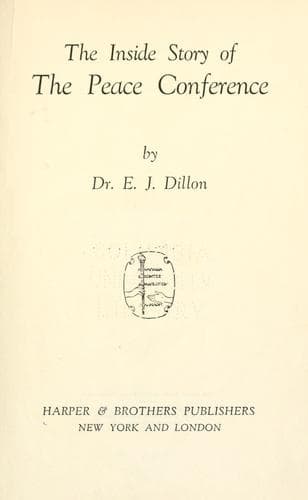
The Inside Story of the Peace ConferenceDillon, Emile Joseph
History
The Inside Story of the Peace Conference
Dillon, Emile Joseph
Paris Peace Conference (1919-1920)
During the progress of the events just sketched there were launched
certain interesting accounts of what was going on below the surface,
which had such impartial and well-informed vouchers that the chronicler
of the Conference cannot pass them over in silence. If true, as they
appear to be, they warrant the belief that two distinct elements lay at
the root of the Secret Council's dealings with Rumania. One of them was
their repugnance to her whole system of government, with its survivals
of feudalism, anti-Semitism, and conservatism. Associated with this was,
people alleged, a wish to provoke a radical and, as they thought,
beneficent change in the entire régime by getting rid of its chiefs.
This plan had been successfully tried against MM. Orlando and Sonnino in
Italy. Their solicitude for this latter aim may have been whetted by a
personal lack of sympathy for the Rumanian delegates, with whom the
Anglo-Saxon chiefs hardly ever conversed. It was no secret that the
Rumanian Premier found it exceedingly difficult to obtain an audience of
his colleague President Wilson, from whom he finally parted almost as
much a stranger as when he first arrived in Paris.
It may not be amiss to record an instance of the methods of the Supreme
Council, for by putting himself in the place of the Rumanian Premier the
reader may the more clearly understand his frame of mind toward that
body. In June the troops of Moritz (or Bela) Kuhn had inflicted a severe
defeat on the Czechoslavs. Thereupon the Secret Council of Four or Five,
whose shortsighted action was answerable for the reverse, decided to
remonstrate with him. Accordingly they requested him to desist from the
offensive. Only then did it occur to them that if he was to withdraw
his armies behind the frontiers, he must be informed where these
frontiers were. They had already been determined in secret by the three
great statesmen, who carefully concealed them not merely from an
inquisitive public, but also from the states concerned. The Rumanian,
Jugoslav and Czechoslovak delegates were, therefore, as much in the dark
on the subject as were rank outsiders and enemies. But as soon as
circumstances forced the hand of all the plenipotentiaries the secret
had to be confided to them all.[176] The Hungarian Dictator pleaded that
if his troops had gone out of bounds it was because the frontiers were
unknown to him. The Czechoslovaks respectfully demurred to one of the
boundaries along the river Ipol which it was difficult to justify and
easy to rectify. But the Rumanian delegation, confronted with the map,
met the decision with a frank protest. For it amounted to the
abandonment of one of their three vital irreducible claims which they
were not empowered to renounce. Consequently they felt unable to
acquiesce in it. But the Supreme Council insisted. The second delegate,
M. Misu, was in consequence obliged to start at once for Bucharest to
consult with the King and the Cabinet and consider what action the
Public-domain text, read in full here on John Shaqi.
Reviews
Reviews
No reviews yet
Be the first to share your thoughts on this work.
Elsewhere in the archive
Join the Discussion
Join the discussion
Sign in to leave a comment or review.
Sign InorCreate an account