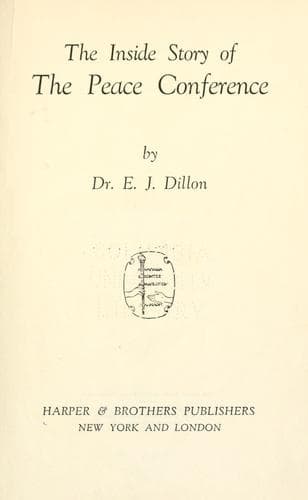
The Inside Story of the Peace ConferenceDillon, Emile Joseph
History
The Inside Story of the Peace Conference
Dillon, Emile Joseph
Paris Peace Conference (1919-1920)
circumstances called for. In the meantime, the entire question, and
together with it some of the practical consequences involved by the
tentative solution, remained in suspense.
When certain clauses of the Peace Treaty, which, although they
materially affected Rumania, had been drafted without the knowledge of
her plenipotentiaries, were quite ready, the Rumanian Premier was
summoned to take cognizance of them. Their tenor surprised and irritated
him. As he felt unable to assent to them, and as the document was to be
presented to the enemy in a day or two, he deemed it his duty to mention
his objections at once. But hardly had he begun when M. Clemenceau arose
and exclaimed, "M. Bratiano, you are here to listen, not to comment."
Stringent measures may have been considered useful and dictatorial
methods indispensable in default of reasoning or suasion, but it was
surely incumbent on those who employed them to choose a form which would
deprive them of their sting or make them less personally painful.
For whatever one may think of the wisdom of the policy adopted by the
Supreme Council toward the unprivileged states, it would be difficult to
justify the manner in which they imposed it. Patience, tact, and suasion
are indispensable requisites in men who assume the functions of leaders
and guides, yet know that military force alone is inadequate to shape
the future after their conception. The delegates could look only to
moral power for the execution of their far-reaching plans, yet they
spurned the means of acquiring it. The best construction one can put
upon their action will represent it as the wrecking of the substance by
the form. By establishing a situation of force throughout Europe the
Council created and sanctioned the principle that it must be maintained
by force.
But the affronted nations did not stop at this mild criticism. They
assailed the policy itself, cast suspicion on the disinterestedness of
the motives that inspired it, and contributed thereby to generate an
atmosphere of distrust in which the frail organism that was shortly to
be called into being could not thrive. Contemplated through this
distorting medium, one set of delegates was taunted with aiming at a
monopoly of imperialism and the other with rank hypocrisy. It is
superfluous to remark that the idealism and lofty aims of the President
of the United States were never questioned by the most reckless
Thersites. The heaviest charges brought against him were weakness of
will, exaggerated self-esteem, impatience of contradiction, and a naive
yearning for something concrete to take home with him, in the shape of a
covenant of peoples.
Public-domain text, read in full here on John Shaqi.
Reviews
Reviews
No reviews yet
Be the first to share your thoughts on this work.
Elsewhere in the archive
Join the Discussion
Join the discussion
Sign in to leave a comment or review.
Sign InorCreate an account