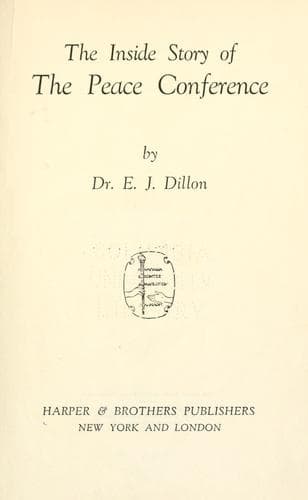
The Inside Story of the Peace ConferenceDillon, Emile Joseph
History
The Inside Story of the Peace Conference
Dillon, Emile Joseph
Paris Peace Conference (1919-1920)
At a Conference, the object of which was the uplifting of the life of
nations from the squalor of sordid ambitions backed by brutal force, to
ideal aims and moral relationship, haggling and chaffering such as this
seemed wholly out of place. It reminded one of "those that sold oxen and
sheep and doves, and the changers of money sitting" in the temple of
Jerusalem who were one day driven out with "a scourge of small cords."
The Rumanians hoped that the hucksters in the latter-day temple of peace
might be got rid of in a similar way; one of them suggested boldly
asking President Wilson himself to say what he thought of the policy
underlying the disconcerting proposal....
The other alleged element of the Supreme Council's attitude needs no
qualification. The mystery that enwrapped the orders from the Conference
which suddenly arrested the march of the Rumanian and Allied troops,
when they were nearing Budapest for the purpose of overthrowing Bela
Kuhn, never perplexed those who claimed to possess trustworthy
information about the goings-on between certain enterprising officers
belonging some to the Allied Army of Occupation and others to the
Hungarian forces. One of these transactions is alleged to have taken
place between Kuhn himself, who is naturally a shrewd observer and hard
bargain-driver, and a certain financial group which for obvious reasons
remained nameless. The object of the compact was the bestowal on the
group of concessions in the Banat in return for an undertaking that the
Bolshevist Dictator would be left in power and subsequently honored by
an invitation to the Conference. The plenipotentiaries' command
arresting the march against Kuhn and their conditional promise to summon
him to the Conference, dovetail with this contract. These undeniable
coincidences are humiliating. The nexus between them was discovered and
announced before the stipulations were carried out.
The Banat had been an apple of discord ever since the close of
hostilities. The country, inhabited chiefly by Rumanians, but with a
considerable admixture of Magyar and Saxon elements, is one of the
richest unexploited regions in Europe. Its mines of gold, zinc, lead,
coal, and iron offer an irresistible temptation to pushing capitalists
and their governments, who feel further attracted by the credible
announcement that it also possesses oil in quantities large enough to
warrant exploitation. It was partly in order to possess herself of these
abundant resources and create an accomplished fact that Serbia, who also
founded her claim on higher ground, laid hands on the administration of
the Banat. But the experiment was disappointing. The Jugoslavs having
failed to maintain themselves there, the bargain just sketched was
entered into by officers of the Hungarian and Allied armies. For
concession-hunters are not fastidious about the nationality or character
of those who can bestow what they happen to be seeking.
Public-domain text, read in full here on John Shaqi.
Reviews
Reviews
No reviews yet
Be the first to share your thoughts on this work.
Elsewhere in the archive
Join the Discussion
Join the discussion
Sign in to leave a comment or review.
Sign InorCreate an account