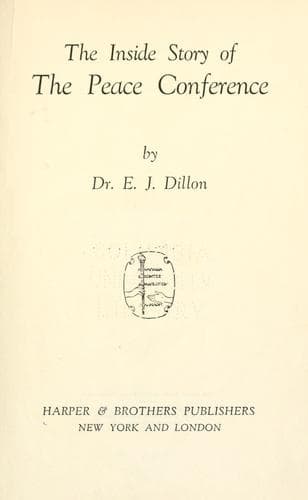
The Inside Story of the Peace ConferenceDillon, Emile Joseph
History
The Inside Story of the Peace Conference
Dillon, Emile Joseph
Paris Peace Conference (1919-1920)
The reports circulating in the French capital respecting vast commercial
enterprises about to be inaugurated by English-speaking peoples and
about proposals that the governments of the countries interested should
facilitate them, were destructive of the respect due to statesmen whose
attachment to lofty ideals should have absorbed every other motive in
their ethico-political activity. Thus it was affirmed by responsible
politicians that an official representative of an English-speaking
country gave expression to the view, which he also attributed to his
government, that henceforth his country should play a much larger part
in the economic life of eastern Europe than any other nation. This, he
added, was a conscious aim which would be steadily pursued, and to the
attainment of which he hoped the politicians and their people would
contribute. So far this, it may be contended, was perfectly legitimate.
But it was further affirmed, and not by idle quidnuncs, that one of
Rumania's prominent men had been informed that Rumania could count on
the good-will and financial assistance of the United States only if her
Premier gave an assurance that, besides the special privileges to be
conferred on the Jewish minority in his country, he would also grant
industrial and commercial concessions to certain Jewish groups and firms
who reside and do business in the United States. And by way of taking
time by the forelock one or more of these firms had already despatched
representatives to Rumania to study and, if possible, earmark the
resources which they proposed to exploit.
Now, to expand the trade of one's country is a legitimate ambition, and
to hold that Jewish firms are the best qualified to develop the
resources of Rumania is a tenable position. But to mix up any commercial
scheme with the ethical regeneration of Europe is, to put it mildly,
impolitic. However unimpeachable the motives of the promoter of such a
project, it is certain to damage both causes which he has at heart. But
the report does not leave the matter here. It goes on to state that a
very definite proposal, smacking of an ultimatum, was finally presented,
which set before the Rumanians two alternatives from which they were to
choose--either the concessions asked for, which would earn for them the
financial assistance of the United States, or else no concessions and no
help.
Public-domain text, read in full here on John Shaqi.
Reviews
Reviews
No reviews yet
Be the first to share your thoughts on this work.
Elsewhere in the archive
Join the Discussion
Join the discussion
Sign in to leave a comment or review.
Sign InorCreate an account