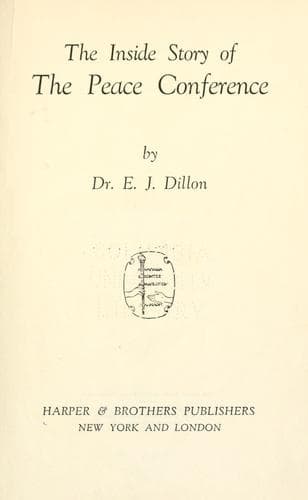
The Inside Story of the Peace ConferenceDillon, Emile Joseph
History
The Inside Story of the Peace Conference
Dillon, Emile Joseph
Paris Peace Conference (1919-1920)
As for the internal development of the nation, it is seemingly hampered
with as many hindrances as the international. It may be likened to the
world after creation, bearing marks of the chaos of the eve. The German
Poles differ considerably from the Austrian, while the Russian Poles are
differentiated from both. The last-named still show traces of recent
servitude in their everyday avocations. They lack the push and the
energy of purpose so necessary nowadays in the struggle for life. The
Austrian Poles in general are reputed to be likewise easy-going, lax,
and more brilliant than solid, while their administrative qualities are
said to be impaired by a leaning toward Oriental methods of transacting
business. The Polish inhabitants of the provinces hitherto under Germany
are people of a different temperament. They have assimilated some of the
best qualities of the Teuton without sacrificing those which are
inherent in men of their own race. A thorough grasp of detail and a gift
for organization characterize their conceptions, and precision,
thoroughness, and conscientiousness are predicated of their methods. If
it be true that the first reform peremptorily called for in the new
republic is an administrative purge, it follows that it can be most
successfully accomplished with the whole-hearted co-operation of the
German Poles, whose superior education fits them to conform their
schemes to the most urgent needs of the nation and the epoch.
The next measure will be internal colonization. There are considerable
tracts of land in what once was Russian Poland, the population of which,
owing to the havoc of war, is abnormally sparse. Some districts, like
that of the Pripet marshes, which even at the best of times had but five
persons to the kilometer, are practically deserts. For the Russian army,
when retreating before the Germans, drove before it a huge population
computed at eight millions, who inhabited the territory to the east of
Brest-Litovsk and northward between Lida and Minsk. Of these eight
millions many perished on the way. A large percentage of the survivors
never returned.[192] Roughly speaking, a couple of millions (mostly
Poles and Jews) went back to their ruined homes. Now the Poles, who are
one of the most prolific races in Europe, might be encouraged to settle
on these thinly populated lands, which they could convert into
ethnographically Polish districts within a relatively short span of
time. These, however, are merely the ideas of a friendly observer, whose
opinion cannot lay claim to any weight.
Public-domain text, read in full here on John Shaqi.
Reviews
Reviews
No reviews yet
Be the first to share your thoughts on this work.
Elsewhere in the archive
Join the Discussion
Join the discussion
Sign in to leave a comment or review.
Sign InorCreate an account