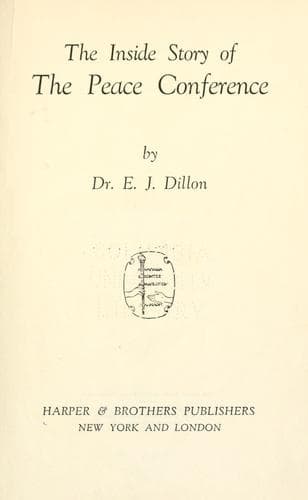
The Inside Story of the Peace ConferenceDillon, Emile Joseph
History
The Inside Story of the Peace Conference
Dillon, Emile Joseph
Paris Peace Conference (1919-1920)
To-day Poland's hope is not, as it has been hitherto, the nobleman, the
professor, and the publicist, but the peasant. The members of this class
are the nucleus of the new nation. It is from their midst that Poland's
future representatives in politics, arts, and science will be drawn.
Already the peasants are having their sons educated in high-schools and
universities, of which the republic has a fair number well supplied with
qualified teachers,[193] and they are resolute adversaries of every
movement tainted with Bolshevism.
Thus the difficulties and dangers with which new Poland will have to
contend are redoubtable. But she stands a good chance of overcoming them
and reaching the goal where lies her one hope of playing a noteworthy
part in reorganized Europe. The indispensable condition of success is
that the current of opinion and sentiment in the country shall buoy up
reforming statesmen. These must not only understand the requirements of
the new epoch and be alive to the necessity of penetrating public
opinion, but also possess the courage to place high social aims at the
head of their life and career. Statesmen of this temper are rare to-day,
but Poland possesses at least one of them. Her resources warrant the
conviction which her chiefs firmly entertain that she may in a
relatively near future acquire the economic leadership of eastern
Europe, and in population, military strength, and area equal France.
Parenthetically it may be observed that the enthusiasm of the Poles for
British institutions and for intimate relations with Great Britain has
perceptibly cooled.
In the limitations to which she is now subjected, her more optimistic
leaders discern the temporarily unavoidable condition of a beneficent
process of working forward toward indefinite amelioration. Their
people's faith, that may one day raise the country above the highest
summit of its past historical development, if it does not reconcile them
to the present, may nerve them to the effort which shall realize that
high consummation in the future.
FOOTNOTES:
[190] Most of my articles written during the last half of the war, and
some during the armistice, were held back on grounds which were
presumably patriotic. I share with those who were instrumental in
keeping them from the public the moral portion of the reward which
consists in the assumption that some high purpose was served by the
suppression.
[191] On April 26, 1917.
[192] Mainly White Russians.
Public-domain text, read in full here on John Shaqi.
Reviews
Reviews
No reviews yet
Be the first to share your thoughts on this work.
Elsewhere in the archive
Join the Discussion
Join the discussion
Sign in to leave a comment or review.
Sign InorCreate an account