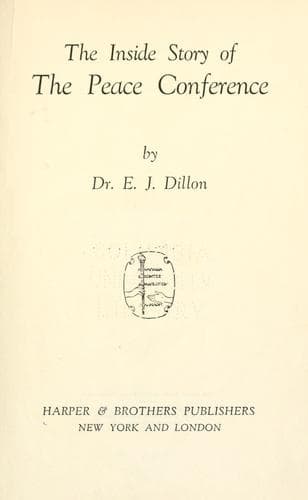
The Inside Story of the Peace ConferenceDillon, Emile Joseph
History
The Inside Story of the Peace Conference
Dillon, Emile Joseph
Paris Peace Conference (1919-1920)
[193] The Poles have universities in Cracow, Warsaw, Lvoff (Lemberg),
Liublin, and will shortly open one in Posen. One Polish statesman
entertains a novel and useful idea which will probably be tested in the
University of Posen. Noticing that the greater the progress of technical
knowledge the less is the advance made in the knowledge of men, which is
perhaps the most pressing need of the new age, this statesman proposes
to create a new type of university, where there would be two principal
sections, one for the study of natural sciences and mathematics, and the
other for the study of men, which would include biology, psychology,
ethnography, sociology, philology, history, etc.
VIII
ITALY
Of all the problems submitted to the Conference, those raised by Italy's
demands may truly be said to have been among the easiest. Whether placed
in the light of the Fourteen Points or of the old system of the rights
of the victors, they would fall into their places almost automatically.
But the peace criteria were identical with neither of those principles.
They consisted of several heterogeneous maxims which were invoked
alternately, Mr. Wilson deciding which was applicable to the particular
case under discussion. And from his judgment there was no appeal.
It is of the essence of statesmanship to be able to put oneself in the
place--one might almost say in the skin--of the foreign peoples and
governments with which one is called upon to deal. But the feat is
arduous and presupposes a variety of conditions which the President was
unable to fulfil. His conception of Europe, for example, was much too
simple. It has been aptly likened to that of the American economist who
once remarked to the manager of an English railway: "You Britishers are
handicapped by having to build your railway lines through cities and
towns. We go to work diligently: we first construct the road and create
the cities afterward."
Public-domain text, read in full here on John Shaqi.
Reviews
Reviews
No reviews yet
Be the first to share your thoughts on this work.
Elsewhere in the archive
Join the Discussion
Join the discussion
Sign in to leave a comment or review.
Sign InorCreate an account