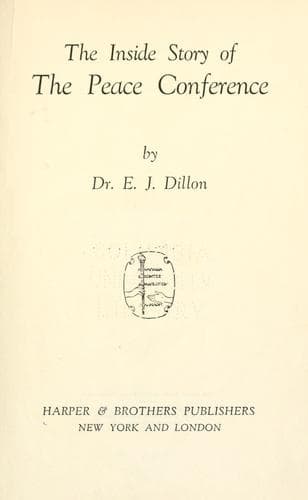
The Inside Story of the Peace ConferenceDillon, Emile Joseph
History
The Inside Story of the Peace Conference
Dillon, Emile Joseph
Paris Peace Conference (1919-1920)
When hostilities broke out, the attitude of the Italian government was a
matter of extreme moment to France and the Entente. Much, perhaps the
fate of Europe, depended on whether they would remain neutral or throw
in their lot with the Teutons. They chose the former alternative and
literally saved the situation. The question of motive is wholly
irrelevant. Later on they were urged to move a step farther and take an
active part against their former allies. But a powerful body of opinion
and sentiment in the country was opposed to military co-operation, on
the ground that the sum total of the results to be obtained by
quiescence would exceed the guerdon of victory won by the side of the
Entente. The correctness of this estimate depended upon many
incalculable factors, among which was the duration of the struggle. The
consensus of opinion was that it would be brief, in which case the terms
dangled before Italy's eyes by the Entente would, it was believed by the
Cabinet, greatly transcend those which the Central Powers were prepared
to offer. Anyhow they were accepted and the compact was negotiated,
signed, and ratified by men whose idealism marred their practical sense,
and whose policy of sacred egotism, resolute in words and feeble in
action, merely impaired the good name of the government without bringing
any corresponding compensation to the country. The world struggle lasted
much longer than the statesmen had dared to anticipate; Italy's
obligations were greatly augmented by Russia's defection, she had to
bear the brunt of all, instead of a part of Austria's forces, whereby
the sacrifices demanded of her became proportionately heavier.
Altogether it is fair to say that the difficulties to be overcome and
the hardships to be endured before the Italian people reached their goal
were and still are but imperfectly realized by their allies. For the
obstacles were gigantic, the effort heroic; alone the results shrank to
disappointing dimensions.
The war over, Italian statesmen confidently believed that those
supererogatory exertions would be appropriately recognized by the
Allies. And this expectation quickly crystallized into territorial
demands. The press which voiced them ruffled the temper of
Anglo-Saxondom by clamoring for more than it was ever likely to concede,
and buoyed up their own nation with illusory hopes, the non-fulfilment
of which was certain to produce national discontent. Curiously enough,
both the government and the press laid the main stress upon territorial
expansion, leaving economic advantages almost wholly out of account.
Public-domain text, read in full here on John Shaqi.
Reviews
Reviews
No reviews yet
Be the first to share your thoughts on this work.
Elsewhere in the archive
Join the Discussion
Join the discussion
Sign in to leave a comment or review.
Sign InorCreate an account