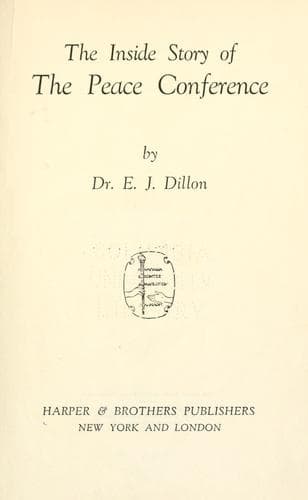
The Inside Story of the Peace ConferenceDillon, Emile Joseph
History
The Inside Story of the Peace Conference
Dillon, Emile Joseph
Paris Peace Conference (1919-1920)
It was at this conjuncture that Mr. Wilson made his appearance and threw
all the pieces on the political chessboard into weird confusion. "You,"
he virtually said, "have been fighting for the dismemberment of your
secular enemy, Austria. Well, she is now dismembered and you have full
satisfaction. Your frontiers shall be extended at her expense, but not
at the expense of the new states which have arisen on her ruins. On the
contrary, their rights will circumscribe your claims and limit your
territorial aggrandizement. Not only can you not have all the additional
territory you covet, but I must refuse to allot even what has been
guaranteed to you by your secret treaty. I refuse to recognize that
because the United States government was no party to it, was, in fact,
wholly unaware of it until recently. New circumstances have transformed
it into a mere scrap of paper."
This language was not understood by the Italian people. For them the
sacredness of treaties was a dogma not to be questioned, and least of
all by the champion of right, justice, and good faith. They had welcomed
the new order preached by the American statesman, but were unable to
reconcile it with the tearing up of existing conventions, the
repudiation of legal rights, the dissolution of alliances. In particular
their treaty with France, Britain, and Russia had contributed
materially to the victory over the common enemy, had in fact saved the
Allies. "It was Italy's intervention," said the chief of the Austrian
General Staff, Conrad von Hoetzendorff, "that brought about the
disaster. Without that the Central Empires would infallibly have won the
war."[195] And there is no reason to doubt his assertion. In truth Italy
had done all she had promised to the Allies, and more. She had
contributed materially to save France--wholly gratuitously. It was also
her neutrality, which she could have bartered, but did not,[196] that
turned the scale at Bucharest against the military intervention of
Rumania on the side of the Teutons.[197] And without the neutrality of
both these countries at the outset of hostilities the course of the
struggle and of European history would have been widely different from
what they have been. And now that the Allies had achieved their aim they
were to refuse to perform their part of the compact in the name, too, of
a moral principle from the operation of which three great Powers were
dispensed. That was the light in which the matter appeared to the
unsophisticated mind of the average Italian, and not to him alone.
Others accustomed to abstract reasoning asked whether the best
preparation for the future régime of right and justice, and all that
these imply, is to transgress existing rights and violate ordinary
justice, and what difference there is between the demoralizing influence
of this procedure and that of professional Bolshevists. There was but
one adequate answer to this objection, and it consisted in the
Public-domain text, read in full here on John Shaqi.
Reviews
Reviews
No reviews yet
Be the first to share your thoughts on this work.
Elsewhere in the archive
Join the Discussion
Join the discussion
Sign in to leave a comment or review.
Sign InorCreate an account