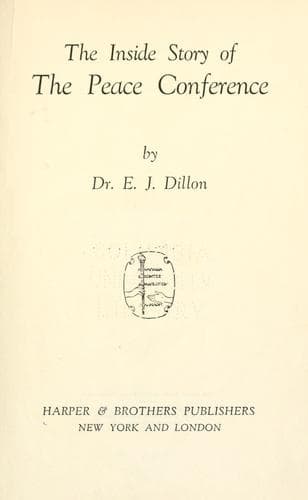
The Inside Story of the Peace ConferenceDillon, Emile Joseph
History
The Inside Story of the Peace Conference
Dillon, Emile Joseph
Paris Peace Conference (1919-1920)
M. Clemenceau, who maintained during the peace negotiations the epithet
"Tiger" which he had earned long before, was alleged to have said in the
course of one of those conversations which were misnamed private, "For
Italy to demand Fiume is to ask for the moon."[200] Officially he took
the side of Mr. Wilson, as did also the British Premier, and Italy's two
allies signified but a cold assent to those other claims which were
covered by their own treaty. But they made no secret of their desire to
see that instrument wholly set aside. Fiume they would not bestow on
their ally, at least not unless she was prepared to offer an equivalent
to the Jugoslavs and to satisfy the President of the United States.
This advocacy of the claims of the Jugoslavs was bitterly resented by
the Italians. For centuries the two peoples had been rivals or enemies,
and during the war the Jugoslavs fought with fury against the Italians.
For Italy the arch-enemy had ever been Austria and Austria was largely
Slav. "Austria," they say, "was the official name given to the cruel
enemy against whom we fought, but it was generally the Croatians and
other Slavs whom our gallant soldiers found facing them, and it was they
who were guilty of the misdeeds from which our armies suffered."
Official documents prove this.[201] Orders of the day issued by the
Austrian Command eulogize "the Serbo-Croatian battalions who vied with
the Austro-German and Hungarian soldiers in resisting the pitfalls dug
by the enemy to cause them to swerve from their fidelity and take the
road to treason.[202] In the last battle which ended the existence of
the Austro-Hungarian monarchy a large contingent of excellent Croatian
troops fought resolutely against the Italian armies."
In Italy an impressive story is told which shows how this transformation
of the enemy of yesterday into the ally of to-day sometimes worked out.
The son of an Italian citizen who was fighting as an aviator was killed
toward the end of the war, in a duel fought in the air, by an Austrian
combatant. Soon after the armistice was signed the sorrowing father
repaired to the place where his son had fallen. He there found an
ex-Austrian officer, the lucky victor and slayer of his son, wearing in
his buttonhole the Jugoslav _cocarde_, who, advancing toward him with
extended hand, uttered the greeting, "You and I are now allies."[203]
The historian may smile at the naïveté of this anecdote, but the
statesman will acknowledge that it characterized the relations between
the inhabitants of the new state and the Italians. One can divine the
feelings of these when they were exhorted to treat their ex-enemies as
friends and allies.
Public-domain text, read in full here on John Shaqi.
Reviews
Reviews
No reviews yet
Be the first to share your thoughts on this work.
Elsewhere in the archive
Join the Discussion
Join the discussion
Sign in to leave a comment or review.
Sign InorCreate an account